
 Postmodern theories of power and politics stress the ever increasing widening of the political debate, particularly the way in which conventional politics is being usurped by new social movements (NSMs). Foucault’s perspectives on the power of discourses is particularly useful in understanding the dynamics behind NSMs, especially in relation to power. While Lyotard’s position regarding the decline of metanarratives is also useful in understanding the postmodern perspective on politics.
This is because people are no longer feel confident (not certain) in relying on the all embracing ideologies underpinning the established political parties in coming up with the answers.
Society, particularly a global society, is far too complex (full of uncertainties) for a single political ideology to solve. Like Foucault, Lyotard sees knowledge as the main source of power in postmodern societies, and is critical of (zero sum game) one single metanarrative (eg Marxism) having all the answers. Instead mechanisms like NSMs provide specialist more localised knowledge to specific issues which takes the power away from politicians and puts it in the hands of civil society organisations (a variable sum approach).
Hallsworth (1994) argues the term ‘new social movements’ is applicable to movements which ‘pose new challenges to the established, cultural, economic and political orders’ through challenging certain issues. This means NSMs tend to fall into two ‘issued based’ categories:
1. issues or threats to the natural environment e.g – Greenpeace; Friends of the Earth; Animal Liberation Front; CND; Fight Against Animal Cruelty in Europe
2. issues which further the civil rights of historically marginalised groups (emancipatory politics) e.g – Campaign Against Racism and Fascism; Action for Rights on Children; Defend Peaceful Protest; Outrage
Then there are NSMs like the Anti-Capitalists who challenge the established economic system of capitalism by utilising new technologies to its advantage.
The above groups differ from conventional party politics and traditional pressure groups (old social movements, OSMs) in several distinct ways:
1. areas not normally defined as being in the political arena, such as housework, domestic violence, prejudice etc are now seen as areas of political interest
2. focus on social and cultural issues instead of the economic issues of traditional social movements
3. they reject traditional formal structures normally found with OSMs, for more informal connections eg Twitter, Facebook such structures have no formal hierarchy or elites
4. distrust for authorities, the government, the business community or the scientific community, instead NSMs challenge the legitimacy of institutions of power and promote their own experts (Garner, 1996) or create their own independent research institutes as SMOs
5. they don’t seek to replace existing political parties with their own movement; instead they use civil disobedience as well as other media to promote their cause
6. most members tend to be young and from the new middle-class (public sector workers)
7. both a global and local orientation such as anti-capitalist movement; this is evident in the slogan ‘think global, act local‘
8. efficient use of new technologies creating global connections and networks; such global networks coordinated the massive demonstrations against the World Trade Organization in Seattle in 1999, against the G8 Meeting in Genoa (Italy) in 2002 and the worldwide protests against the War in Iraq in 2003
9. they emerged in from a growth in liberal democratic societies in the 1960s and 1970s (Hallsworth, 1994)
However the above distinction between OSMs and NSMs is not necessarily seen as so clear cut. Cohen and Shirin argue against Hallsworth’s position citing exmaples of OSMs which they believe meet the criteria identified above but were formed ‘long before 1960s’.
 For Cohen and Shirin there are numerous social movements founded before 1960s which though identified as traditional pressure groups (OSMs) they clearly meet the NSM criteria. One of these being the Anti-Apartheid Movement, which clearly show concerns for both power and inequality (emancipatory politics). Nevertheless Cohen and Shirin agree there are some clearly distinctions with contemporary NSMs:
1. there use of new-media for tactical and innovative protesting
2. the use of new-media in moving local struggles to global battles
Let’s take a look at an email from 38 Degrees to see if they’re a pressure group or NSM?
 It will have become clear by now that official statistics do not record the complete picture when it comes to establishing how much crime there actually is (that’s why there’s the British Crime Survey & Self-Report Studies). Edwin Sutherland was the first sociologist to study another ‘dark-area’ of crime now know as white-collar crimes.
White-collar crimes are ‘crimes committed by persons of high social status and respectability in the course of their occupations (Sutherland, 1960). These crimes include professional misconduct (by doctors, solicitors etc), breaking of health and safety regulations and misrepresentations in advertising.
Sutherland’s study of white collar crime was prompted by the view that criminology had incorrectly focused on social determinants of crime, such as family background and level of wealth. What made Sutherland’s view so important was his ‘discovery’ that crime is committed at all levels of society, and by people across all socio-economic backgrounds. In particular, Sutherland argued crime is often committed by persons operating through large and powerful organizations.
Nelken challenged Sutherland’s definition by arguing white-collar crimes can be committed by people of high social status beyond the confines of their occupaption. Indeed crimes such as corporate crime is committed by organisations rather than individuals.
Whatever the exact definition, white-collar crime is extensive. The following link to the Huffington Post identifies several high-profile white-collar crimes while this BBC link identifies MP expenses scandal. which clearly shows the extent to which crime cuts across all socio-economic backgrounds.
However the problem with assessing the extent of white-collar crime remains, particularly as the three traditional methods of recoding crime data remain impotent at recording white-collar crime because:
1. It’s difficult to detect crimes within the workplace, mainly because their are no ‘victims’ ( a school-teacher regularly taking packs of paper home, who will notice the loss)
2. Someone in receipt of a bribe, in order to cancel a parking ticket, won’t report the incident and neither will the proponent as they’re both guilty
 Most of the following dialogue comes from thecrankysociologist.com as it provides a first-hand account of these challenging ideas in action.
For Emile Durkheim, anomie was a state of normlessness, a society where individuals’ connections with each other had become frayed (due to lack of regulations). This happened during times of massive social change and could lead to heavier patterns of suicide (because aspirations can’t be achieved). For Durkheim, the other critical aspect of anomie was that it existed when there was an absence in social regulations that would help to guide behaviours. Or put in more Dur.
That is partly what we see in this clip from HBO’s awesome drama, The Wire (season 3). Here Major Colvin (a.k.a., “Bunny”, pictured below) has established a safe zone of sorts for mid-level drug dealers from a variety of gangs. This sector becomes called “Hamsterdam” after a youth misinterprets the area being compared to Amsterdam where drug use is largely decriminalized. There are very little regulations in “Hamsterdam,” as the drug dealers may freely sell their products while law enforcement turns a blind eye, as long as there is no overt physical violence (the extent of crime hasn’t become dysfunctional).
For Merton, anomie happened when there was a loss of means, meaning society didn’t care about the pathways by which people gained wealth, as long as they got wealthy. Or put another way, getting wealthy was more important than the processes by which someone made/got money. This was because Merton argued socially produced aspirations (the American Dream) were unobtainable for most people. Therefore anomie was caused by strains in the social structures – the American Dream over emphasised the need to achieve financial success.
In fictional “Hamsterdam,” Merton would point out the structurally sponsored American virtue of ambition ends up creating deviant behaviour. The reality for many people the socially produced desire to aspire isn’t possible by conventional/legitimate means, therefore the pressure to deviate from the norm is increased.
Merton would point out the persistent goal for profit creates ‘breakdowns in the cultural structure’, which means there are no social morals that would otherwise guide people on how to reach those goals appropriately. So, the dealers will sell drugs (illegitimate) to whoever will buy, something that’s facilitated in “Hamsterdam.” In “Hamsterdam,” we see a combination of normlessness regarding both regulations and means…it’s total anomie for both Durkheim and Merton but they both have differing explanations of why this has occurred.
Therefore you need to watch the clip below are work out whether Durkheim or Merton have to best explanation as to the state of anomie the fictional character ‘Bubbles’ finds himself in.
Before moving on to Merton, it is best if we run through some key aspects of Durkheim. As we have discovered  Durkheim’s position is crime is a consequence of societies based on values of competitive individualism structured within a high division of labour (competition and the division of labour being a feature of advanced, industrialized countries).
In such dynamic conditions according to Durkheim, crime is an ‘integral part of all healthy societies’. It’s inevitability being not every member of society will automatically sign-up to society’s value-consensus as everyone is open to different influences.
Crime therefore is inevitable as social change begins with some sort of deviance from the norm. Crime only becomes an issue – dysfunctional – when crime rates are too high or low. In such situations society’s regulations would be seen to be either too restrictive or too lose respectively. For example the rate at which individuals deviate from the norm is related to the degree of integration and cohesiveness between society’s members.
The higher the rate of suicides (or crime) in times of economic crisis is explained by the lack of regulation in society. This is because society encourages aspirational individualism, which in times when these aspirations can’t be realised. Therefore a state of anomie (normlessness) will occur until occur leading to increased incidence of suicide (or crime) unless new regulations are imposed.
It was this idea of the unobtainable dream as a cause of anomie, which Merton developed.
- Merton said the American Dream or meritocracy is seen as available to everyone but in reality people are restricted by social structures caused a ‘strain to anomie’ or frustration
- Merton said the very nature of society generates crime and deviance
- Because aspirations are encouraged to be endless, but are blocked by what the social structures make possible (this links back to the point above how Merton said not all institutions provided a positive function)
- Merton identified 5 adaptations to these social structures
Merton’s 5 adaptations, were ways in which individuals found ways of overcoming this strain to anomie created by social structures
Conformity – acceptance of goals and means, and is the one taken up by most people
Innovation – where people accept the need to achieve their goals but are prepared to do so irrespective of the social cost. Therefore any illegal or immoral means to achieving wealth become acceptable. This tends to be undertaken by the working-classes because they tend to have less opportunities to achieve as they’re stratified so low in society, that any escape through ‘legal’ means is limited.
Ritualism – this is particularly taken up by the middle-classes as they ‘get there head down’ and follow the rules and keep their employer happy and go out of their way not to ‘rock the boat’
Retreatism – you give up and drop-out of society because you’ll never achieve anything and so retreat into a world of drugs and alcohol
Rebellion – you start a revolution to change things. And so you reject the existing norms, values and aspirations and seek to create a set of new ones through revolutionary means
In effect Merton is arguing the very nature of modern Western society creates crime and deviance. The more Western culture encourages people to live the material dream and in promoting such a lifestyle societal regulation is diminished and people criminality especially through ‘innovation’ becomes common-place! Therefore in the same way Durkheim argues ‘social facts’ exist and need to be recognised in order to understand individual and group action. Merton uses the concept of ‘social facts’ as determinant in cultural goals, in this case the American Dream. The following page allows you grasp these ideas more fully by seeing anomie in action.
Durkheim’s and Merton’s theory of anomie paved the way for the creation of subcultural theories of crime and deviance. This was due to Albert Cohen explaining the actions of lower-class subcultures by examining their adaptations (Merton used the term adaptations) to the dominant values of the middle-classes
Task – Assess the usefulness of anomie in understanding crime and deviance
Much of our information about crime comes from the media ( newspapers, television, films etc). This information tells us about local as well as global events. From this position we can see the media plays an important role in our perception and construction of the social world.
Much of this construction about the social world has been regarding the extent of crime in society. Crime stories have tended to dominate media content, with readers assuming a common-sense view that the media merely reports the facts of a ‘common-sense’ process – the police apprehend criminals, the courts punish them and the media reports this process.
In analysing this effect Hall et al (1975) proposed replacing the ‘common-sense’ process with the more complex one below: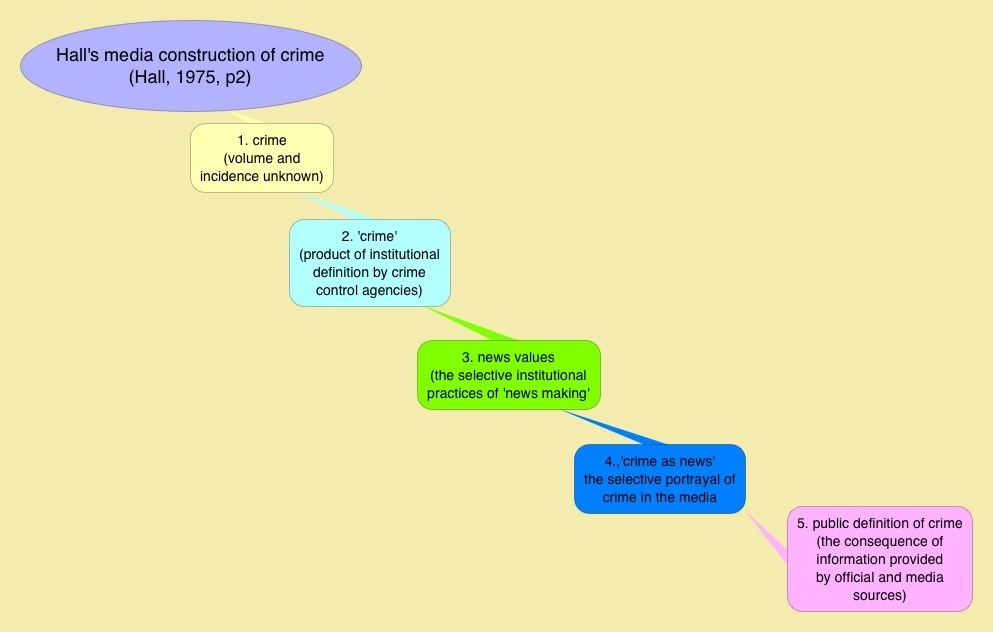
However Williams and Dickinson found this process was far more complex. Their research of the national press in June 1989 found that on average 12.7% of news reports were about crime. With tabloid newspapers devoting even more space to crime stories. These figures increased to 60% when news stories reported on cases of personal violence (compared to 5% of all reported crimes reported to the police being cases of personal violence) (Williams and Dickinson 1993, p40)
Ditton and Duffy’s studies also showed how newspapers distort the official picture of crime known to the police (Ditton and Duffy, 1983, p164). For example in Birmingham offences against the person (robbery and assault) accounted for less than 6% of known crimes but occupied 52.7% of the space given to crime stories (Smith, 1984, p290).
Some sociologists argue the media’s search for newsworthiness is a reason crime stories dominate news content. Stephen Box said ’90 per cent of media space devoted to the reportage of crimes, concentrates on serious crimes such as wilful homicide, forcible rape, aggravated assault, burglary and larceny and crimes currently fanning social hysteria such as trafficking and drug abuse’ (Box, 1981, p39).
Chibnall argues such emphasis is due to popular journalism is built around a particular set of news values which select (specific events to include or omit) in order to present such content in a dramatic way (through selecting certain headline, language and imagery).
Many such headlines and images, particularly with crime reporting, relies heavily on the application of stereotypes. Such processes are clearly evident regarding female criminality. The master status of the female criminal is constructed around hegemonic charateristics of the deviant women as having masculine traits.
Hutter and Williams (1981, p23) argue such stereotypes are built on established gender roles which defines female deviancy as ‘unnatural’ or ‘abnormal’.
Stanley Cohen’s research into moral panics, identified how the increased reporting on a category of antisocial behaviour or other undesirable events led to moral panics.
Deviancy amplification spiral is the term often used to describe the media hype generated over on issue which causes a moral panic. The process of moral panics is best explained via the cultural effects model.
- Moral Panic –an exaggerated fear or outrage by the media and the audience, over an issue that has been blown out of proportion by the media in the first place. These become issues of public concern, about the behaviour of certain groups of people who are seen as a threat to the moral order and stability of society.
- Folk Devils – these are groups targeted by a moral panic, fictional or not. They are groups seen by the media as evil or deviant and a threat to the moral well being of society.
- Self-fulfilling Prophecy – a prediction that makes itself become true. An external view is internalized by a person or a group and taken on in their actions and behaviour.
The term moral panic was developed by Stan Cohen. BBC’s Thinking Aloud discusses the work of sociologist Stan Cohen (1942-2013)
It is based on a false or exaggerated idea that some group’s behaviour is labelled as deviant and is a menace to society.
Cohen used the term ‘folk devil’ to refer to such groups. Laurie Taylor discusses a contemporary moral panic on Boy Racers with Dr Karen Lumsden author of Racer Culture: Youth, Masculinity & Deviance.
‘Moral panics’ are generally fuelled by media coverage of social issues.
• Mods & Rockers (1960s) (Cohen)
• Mugging in the 1970s (Hall et al).
• HIV/Aids (1980s).
• Satanic child abuse (1980s).
• Heroin and crack cocaine distribution (1980s/1990s).
• Video-nasties (1980/1990s).
• Guns (1990s and 2000s)
• Acid raves, Ecstasy, (1990s) (Thornton and Critcher).
• Male under-achievement in education (1990s).
• Asylum seekers (2000s).
• Islamic terrorism (2000s)
• Knife crime (2000s)
Test Yourself
What is politics?
Study questions for learning and understanding
What is power?
Study questions for learning and understanding
Different types of power
Women Politicians and the Media
Study questions for learning and understanding
How does the state use its power?
Pluralist theories of the state
New Right theories of the state
Study questions for learning and understanding
Why have different political parties?
Conservative
Labour
Liberal Democrats
Ukip
Greens
Ideological shifts of political parties
Gaining political power
Election results 1997 – 2010 with explanations
Overview on voting behaviour from 1970s – Butler and Stokes – Sarlvik and Crewe
Mrs Thatcher’s influence on voting behaviour
Media influences on voting behaviour
Influences on voting behaviour
Questions for learning and understanding
Pressure groups and new social movements (NSMs)
Difference between traditional pressure groups and NSMs
Study questions for learning and understanding
Study questions for learning and understanding B
Media power and politics
Voting by newspaper readership
Study questions for learning and understanding
Do media owners control content?
Pluralist view of media owners
Neo-Marxist view of media owners
Media influences on voting behaviour
Rupert Murdoch’s influence on voting behaviour
Study questions for learning and understanding
Globalisation
Revision exercises
Defining crime and deviance
Media’s portrayal of crime
Media and crime revision notes
Crime statistics
British Crime Survey (victimisation studies)
Types of crime
Global crime revision notes explanation by video
Evaluating perspectives of crime
Strengths verses weaknesses of the competing perspectives
Competing perspectives of crime
Functionalist explanation by video revision notes
Merton’s Strain Theory explanation by video revision notes
Subcultural explanation by video revision notes
Interactionist explanation by video revision notes
Marxist explanation by video revision notes
Neo-Marxist explanation by video revision notes
Feminist explanation by audio revision notes
Right Realist explanation by video revision notes
Left Realist explanation by video revision notes
Age, social-class, locality and crime
Social-class and crime revision notes
Locality and crime revision notes
Ethnicity and crime
Folk devils and crime revision notes
Crime as a political act revision notes
Left-realism and ethnicity revision notes
Labelling theory
Globalisation and crime
Features of globalisation and crime revision notes
Control, punishment and victimisation
Prevention and control of crime revision notes
Sociological explanations of punishment
Victims of crime
Explaining victimisation
The distribution of victimisation
Sociology of suicide
Durkheim’s study of suicide revision notes
Douglas and suicide revision notes
Atkinson and suicide revision notes
S. Taylor and suicide revision notes
Suicide revision image









 This is a useful read on the shift from partisan to consumerist voting patterns (first couple of pages only), while this BBC page provides an overview on what influences voting behaviour particularly social class. The BBC Today clip below, from May 2015, provides an excellent context regarding the role of social class in voting behaviour.
- Visit this Guardian page for information on several UK General Elections in order to provide you with a context.
- Visit this BBC page as well as this Independent page to more about ethnicity and voting behaviour.
- This Guardian page explains about the influence of gender and voting patterns of behaviour.
The Andrew Marr clip below from April 2015 provides you with an insight into why young people (18-25 year olds) are turning away from voting.
In 2014 we also had the Russell Brand effect, which provides one perspective as to why people are turned off politics. You can read more on this here and on this page as well as watching the clip below.
 sociologytwynham.com