
So far we’ve covered a number of perspectives of the state. We’ve seen pluralists argue society-centred theorists’ argue the state reflects the views of its people; elite theorists put power in the hands of a small minority; Marxists sees the state as being shaped by a ruling-class; while neo-Marxists argue the state has relative autonomy from the ruling class, but as the state was part if the superstructure it inevitably serves the interests of the ruling-class.
For Nordlinger all the above perspectives are effectively all society-centred because social-groups – be they large or small – influence the state in some form or other. In contrast Nordlinger’s argument is the state acts independent to its people, to the extent it acts autonomously through three mechanisms.
Type 1 – state autonomy occurs when the state has different wishes and desires to the people – usually via civil servants who can
- set the agenda through decision or non-decision making
- use honours system or government contracts to opponents
Type 2 – state autonomy by manipulating public opinion to support government thus wining the argument, for example Ian Duncan-Smith manipulated jobless figures in relation to benefit cap as well as the state trying to manipulate public opinion to further reduce access to legal aid
Type 3– state autonomy when the state supports policies by powerful interest groups in society for example Britain’s Israel Lobby
Another influential state-centred theorist is Theda Skocpol. Like Nordlinger she argues pluralists, Marxists and neo-Marxists all assume the state is shaped by external pressures because state’s are autonomous structures that have interests all of their own which it can act on because:
- sovereignty alone gives the state reason enough to do as it wishes
- the more tax revenue it collects the power it has, therefore the richer a nation the powerful it becomes
- the wealthier a state the better educated civil servants it can employ which deprives non-state organisations from employing more able individuals who would then challenge the state’s power.
For Skocpol then a state ability to hold power or not depends on the extent to which opposition groups in society are organised or not. Therefore a state becomes more powerful if it stops or outlaws opposition groups. But states are vulnerable to globalised terror, global markets, think of Greece and Ireland and are vulnerable to internal organised groups.
For example in United States and the United Kingdom, the last few years have seen a flood of collective action, as primarily middle class groups – affluent, well-educated white adults in the Tea Party, disaffected college students in the Occupy Wall Street and Occupy London movements – have taken to the streets. While not genuinely embracing revolutionary tactics, such protests are linked by grievances that transcend singular policies and speak to a more general displeasure with the system as it is operating, part of a grand narrative that professional politicians have lost touch with citizens and are unwilling to defy vested interests to make tough decisions.
Certainly, in terms of class interests alone, the “squeezed middle” in developed countries could feasibly make common cause with more traditionally repressed fragments of society to realise an overhaul not just of one particular regime but the system itself. The complete article this is taken from.
You can read more on Skocpol’s thoughts in a brief interview in May 2013.
Before pressing on with our understanding of postmodernism, it’s worth taking a pause to recognise the extent to which the term certainty was used to explain modernist ideals, as certainty and uncertainty are two words which become very useful tools in gaining understanding of postmodernism.
Firstly there are diverse strands to postmodernism from academics such as Derrida, Lyotard, Foucault and Rorty. Nevertheless they all share the principle of questioning the certainties of the Enlightenment project first broached by Nietzsche. The German philosopher had a profound impact on the way we think from the early stages of the 20th century by questioning moral and intellectual certainties.; particularly the notion knowledge is inherently objective and good.
For postmodernists knowledge isn’t objective because the universe isn’t mechanistic but relative. Objective knowledge isn’t there waiting to be discovered and understood instead knowledge is relative and indeterminate. For Lyotard knowledge had lost its objectivity as it had become another commodity (Delanty, 2000, p143) From this ‘we should consider postmodernity as either an increase of scepticism or, at least, a greater reservation (uncertainty) with regard to Grand Narratives and their goals’ (Lyotard, 1994, p189).
One example of this is the growth in new social movements such as Chime for Change creating a new discourse (which creates uncertainty or) in order to displace the existing ‘certainty’ (established truth) about something – in this case women’s social roles. Similarly Rojek and Roberts argue our identities are becoming much more uncertain. For example if you looked at a group of young people 50 years’ ago you’d be certain they were all heterosexual. However if you looked at a similar group of youngsters today you’d be ‘uncertain’ as to their individual sexuality.
Other examples of to which we can apply sociology of postmodernism become apparent when we look back at the ‘certainties’ of the social world for past generations. In the past people were brought up with certainties about having a career with one employer; a marriage for life; doctors had all the answers. In contrast we live in times of uncertainties regarding employment; pre-nuptial agreements; the growth in alternative medicine.
For French philosopher Michael Foucault these uncertainties are inevitable outcomes of Nietzsche’s ‘will to power’. Though Foucault’s position does differ slightly by seeing knowledge as an outcome of relations of power manifest through discursive claims to truth. Foucault, like Nietzsche concludes that ‘truth’ or objectivity is an outcome of which discourse dominates in a particular period (creating uncertainty about truth). An explanation of the power of discourses is available.
From this we can see modernity was about the certainty objective knowledge provides while postmodern thinkers see objective knowledge as relative and therefore uncertain. An accessible way of explaining this is by applying Lyotard’s quote above regarding the uncertainty of Grand Narratives to the formation of identity -(there’s more detailed reading on Nietzsche and postmodernism).
The image below provides more examples of this tension between certainty and uncertainty in the context of understanding for A’ level Sociology shown below.


The best way to access postmodernism is to recognise the sociological theory of postmodernism develops from the concept of modernity.
Modernity (modernist social theory) is all the grand theories (sometimes known as Grand Narratives by postmodernists) you’ve been learning such as Maxism, Funtionalism, Feminism, Symbolic Interactionism etc. The reason these are known as modernist is in their assumption that each their own theory had all the answers and so established the ‘truth’. Therefore functionalists have an established truth about what a proper family should look like, a nuclear family. However this ‘truth’ doesn’t fit so well with family diversity or new emerging co-parent families http://www.theguardian.com/lifeandstyle/2013/dec/15/meet-the-co-parents-modern-families
Modernism stems from the Enlightenment (otherwise known as the Age of Reason) period in human history. Rene Descartes laid the philosophical foundational for modernist thinking with his focus on the autonomous rational thinking self. In many ways Issac Newton optimised the thinking self by providing a scientific framework for modernity by explaining the physical world around us as a mechanical system with laws which could be discovered and explained by the objective human mind.
In many ways the industrial revolution was a manifestation of this change. The industrial revolution was a time where our modern values were born. Industry and commerce were slowly becoming the driving force of human existence with the growth in science helping us understand how the world around us functioned (now you can get the idea why the academic subject of sociology came into being).
As an aside – but also as a way of highlighting the connections between academic subjects no matter what level you’re studying at – the influence the mechanisation of society had on Humanities and the Arts is explored in these BBC documentaries through the work of Shelly, Keats and Mary Shelly.
The thinking, objective self uncovering the discoverable laws of the universe paved the way for what Hambermas termed the ‘Enlightenment project’ (Hambermas, 1992, p162). By this he means the enlightened self can unlock the secrets of the physical world around him in order to master it and improve the world around him/her (can you detect a similarity with Durkheim’s thinking regarding social-facts?)
Within the Enlightenment project is the assumption modernist thinking is objective, good and certain (J.M.Kee,1990). This pursuit of dispassionate objective knowledge assumes absolute faith in the specialist, neutral observer who has gained expertise in their chosen field of expertise. From this human progress through the application of science becomes inevitable, allowing mankind to control by gaining knowledge and understanding about the physical world around him.
In many ways Mr Spock from the original Star Trek series optimises modernist ideals described above. There was a certainty his objective and scientific solutions would regularly solved the challenges he and his colleagues faced, which is clearly evident in the clip below. Postmodern thinkers question these certainties.
To help the reader establish a context for feminist theory a broader historical overview is available. But before you follow the link and/or read about feminism below, the following video ‘What chance does a young girl have?’ will help you to understand why there’s a feminist movement in the first place.
This page provides example of how women’s achievements can be ‘airbrushed’ from history. A point evident in the way women struggle in the political arena. While this page helps provide you with a context for the rise of the feminist movement.
In order to understand the rise of feminist movement it’s worth noting some of the difficulties women have faced. First, women in late nineteenth century England were not recognized as individuals in either the legal or the liberal theoretical sense. Men still held formal power over the rest of the family, and women were mostly excluded from the public sphere. John Stuart Mill and Taylor, along with some early United States feminists such as Elizabeth Cady Stanton and Susan B. Anthony, argued that the equality of women required full citizenship for women. This would include giving women enfranchisement.
After 1865, when John Stuart Mill was in the English Parliament, he fought for women’s suffrage. He also fought “to amend the laws that gave husbands control over their wives’ money and property.” He also supported the campaign for birth control information to be available, and was active in other campaigns that were aimed at assisting women and children (Eisenstein, p. 128).
In UK, there is now formal equality in most areas of social life, with women and men having the same legal rights; but many feminists would argue though that this is only formal equality, not true equality as there’s still inequality in pay. The extent to which women still suffer from inequality is evident in the Chime for Change, which meets the criteria of being a new social movement. This movement founded by Beyoncé Knowles-Carter; Frida Giannini; Salma Hayek Pinault encourages Catapult projects.
Nevertheless many feminists would point out the extent to which patriarchy still dominates the social world. It is argued the former Australian Prime Minister Julia Gillard was driven out of office Australia’s misogynist culture a point you can see she raised in the Australian Parliament in this Youtube clip.
As sociologists using Stephen Lukes’ analysis of power, we need to consider which face of power best explains Julia Gillard’s removal from office.
Notwithstanding the persistent gender inequalities it is important to fully appreciate the context in which sociological theory was developing, particularly in relation to the public and private spheres. Social theories emerged in Europe as a way of explaining the society that emerged as part of the modern era from studying the public sphere of social life.
As a result, early sociological theory paid little attention to the private spaces predominantly occupied by women. By ignoring this significant part of the social world, early sociologists had little or no theory of gender relations, sexuality, or male/female inequalities – essential aspects of our contemporary social theory. Feminists and other contemporary sociologists identified shortcomings with major classical sociological theories.
The following is an accessible insight into functionalist sociological theory, while a more detailed analysis of feminism is available.
Feminist social theory explores the fact that if you’re a woman your chances of becoming prime minister, a doctor, a solicitor, or a business leader are very much less than if you’re a man.
Historically it was argued women were ‘naturally’ inferior to men because of their biology. Feminist critiques of society are based on the idea that people are born more or less equal it’s just the way society is organised which causes the inequalities. Feminists’ argue because society is organised on patriarchal lines women suffer from inequalities.
This is best illustrated through the education system. Since the 1988 Education Reform Act, UK, girls have been given the same opportunities as boys resulting in girls doing better than boys in most subjects.
However feminists point out it just wasn’t society which was patriarchal, sociology was also patriarchal. For example the Marxist debate on social-class occurred on the assumption the only gender which suffered from class subjugation was men. For Marx it was as if women were add-ons, bits bolted on to their husbands like some sort of accessory.
Durkheim too discussed the division of labour as if women were ‘naturally’ occupying the private world of the home because of their biology. Therefore women were never a part of Durkheim’s ‘social-facts’ which means Durkheim’s ‘scientific’ approach was hardly that if he ignored a complete gender -women!
The image at the bottom of the page covers more of these key themes you need to grasp to fully understand. While the ideas feminist academics are available in much greater depth in the following pages.
by Sam Cook a former student
Marx’s conflict approach was developed in 19th century by Karl Marx (1818-83) in the context of the rise of modernity. Marx argued wealth and power were unequally distributed in society and sought to explain how one minority group (1% ruling-class) in society maintained its dominance over the majority (working-class).
Marx’s main argument was capitalism was a new form of social organisation (new at the time he writing) born out of the industrial revolution. The industrial revolution saw people move from living in the country to the towns. This revolution was an outcome of modernity, where mankind started to believe it could understand and therefore control the world around him/her. One useful example of this ‘understanding’ is evident in Adam Smith’s work on economics.
Adam Smith was the first theorist of what we commonly refer to as capitalism and readers can listen to Laurie Taylor and guests discussing the extent of Smith’s influence. Though Adam Smith never used the term capitalism, Karl Marx did when he identified the exploitation of workers within Adam Smith’s economic model.
Marx argued the bourgeoisie (ruling-class) used the capitalist economic system to extract surplus value from the proletariat (working-class). Marxism is seen as a conflict approach because of the class conflict the above system creates between the two social-classes ( the opposite of the consensual approach Durkheim, Parsons etc. argue). Contemporary Marxists argue globalisation has created a global bourgeoisie based on the evidence of a global 1% of ruling-class owning the means of production.
The above position brought to life the significance of social-class, whereas functionalists Davis & Moore discuss stratification as a consensual division of labour structured around role allocation. Marx asserts a division of labour (yes, same term as functionalists) as being an exploitative system reliant on the ruling-class exploiting the working-class in order to make surplus profit from working-class labour force. Marx said what’s clever about this process is the working-class aren’t even aware they’re being exploited because ruling-class ideology creates a false-consciousness for the working classes.
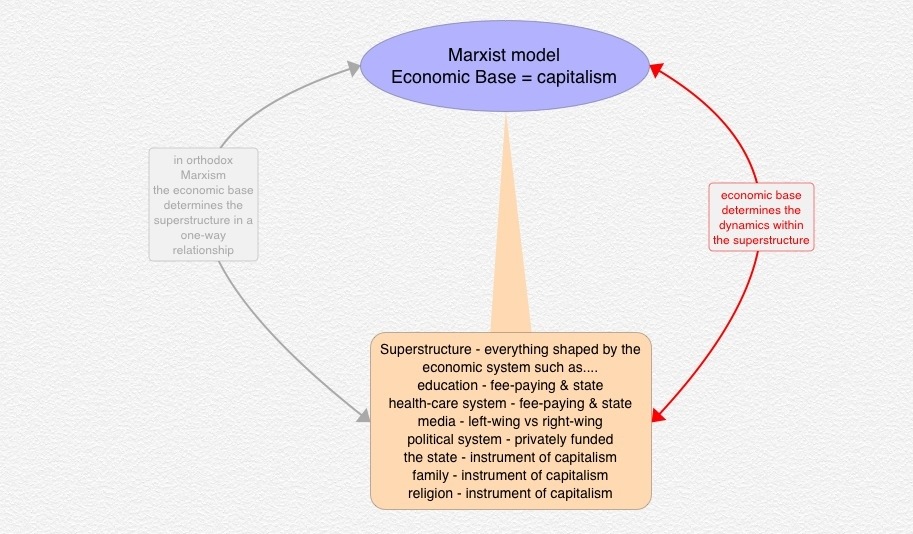
From the above his main argument is the capitalist means of production (economic base) shapes (determines) the rest of society (superstructure). To put it another way capitalist production influences the way the rest of society operates. For example everything is run for profit, hospitals, schools, retirement homes etc. and this is seen as normal and inevitable by the working-classes.
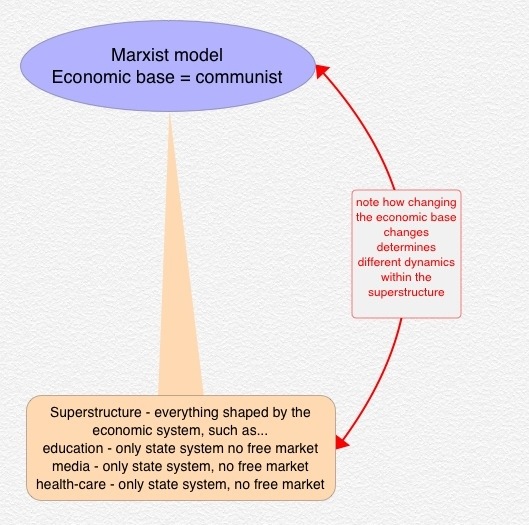
To better understand the relationship between the economic base and superstructure look at the image below. Then examine the image beneath it and see what happens when the economic base is changed.
Parsons argued any successful social system has four functional prerequisites – adaptation; goal attainment; integration and pattern maintenance.
Adaptation – in order to survive any society needs the basics of food and shelter. Having these gives any society control over its environment. A society needs a functioning economy to provide this.
Goal attainment – all societies need to provide some sort of collective goals for it members to aspire to. Governments set goals such as New Labour setting a target of 50% of school leavers would attend university. To do deliver such goals governments provide the resources, laws and other institutional mechanisms so such goals can be met.
Integration – all societies need a legal system in order to mediate any conflict and therefore protect the social system from breaking down.
Pattern maintenance – this prerequisite is provided by institutions like education and the family. These institutions exist to reaffirm the essential values needed for society to function. For Parsons the key institution in passing on such basic values is religion.
As we can see Parsons’ position is any social system can be analysed on the basis of what function an institution plays in cultivating the four prerequisites. However the assumption in the above is the social system is in a constant state of stability. As we all know society is never stable and is susceptible to ‘social change’ as issues arise which threaten any stability, for example high unemployment. Parsons explained how his four functional perquisites compensate for each other in order to accommodate social change; he termed such change as ‘social evolution’. Social evolution is an inevitable form of social development, as societies become more complex both culturally and economically.
For example if a society has rising unemployment government policy could be to extend the school leaving age to 18 – thus the functional prerequisite of goal attainment can be applied in understanding why a new ‘goal’ has been created. Though a new goal of achievement has been established within the traditional framework of universalism, it has been adapted to meet the needs of a modern society by allowing wide variations as to what achievement is and how you might achieve such a goal. For example though the school leaving age is 18, an individual doesn’t have to stay at school per se, but can be trained in the workplace – differentiated levels of achievement fulfilling role allocation.
By having social differentiation Parsons argued the functional prerequisite of integration is maintained as individuals are allocated differentiated roles through a value consensus which retains social equilibrium and social order.
The image below covers most aspects covered in the last three pages. Follow this link to go back to the first functionalism page or return to the sociological theory page.

Talcott Parsons developed Durkheim’s ideas in his publications during the 1940s and 1950s looking at how the maintenance of social order is possible. The function of social order is best understood through functional prerequisites, social equilibrium and value consensus. Parsons argued these three concepts are useful in understanding how social order is maintained because they explain how society shares a commitment to common values. In Parsons and Durkheim’s view people obey social rules because they believe it’s the right thing to do – a moral commitment.
Value consensus describes this moral commitment. Being committed to sharing the same values helps establish a common identity. Having a common identity helps with build mutual cooperation, unity and social goals. Social goals give direction to any shared values. For example the shared value of children being brought up in a family with two parents is justified by the goal of such a social structure providing long term stability. Keeping with the family, each parent has a unique role, with each role putting values and goals into action. These roles establish norms which establish how normal patterns of behaviour are standardised, replicated and natural. As we can see norms, roles and goals establish a value consensus, which in turn provides the foundation for social order.
Parsons sought to analyse how values become woven into the fabric of society, passed on from one generation to the next – a process known as institutionalised (a well-established pattern of behaviour or of relationships which is accepted as a fundamental part of that culture such as the family).
Socialisation is the term Parsons turned to. Socialisation is the mechanism through which society’s values are transmitted from one generation to the next – visit the family page for primary socialisation and education page for secondary socialisation. These two institutions (family and education) socialise individuals, but they also act as agents of social control by guiding individuals away from deviance. Together these institutions use socialisation and social control as a means of providing social equilibrium (stability) to the social system (society).
It’s important to remember Parsons viewed society as a system (social system); any system is dependent on each component functioning correctly. For example the institution of the family provides children with the correct value consensus to attend school helping the social system to continue functioning. Such basic needs are known as functional prerequisites.
Numerous functionalists have sought to identify common characteristics different societies have in order to identify a key ingredient – prerequisite. Continuing with the family, George Murdock research found the family unit is a common denominator in all societies while Davis and Moore claimed all societies are stratified.
Parsons argued any successful social system has four functional prerequisites – adaptation; goal attainment; integration and pattern maintenance. These functional prerequisites are explained in further detail on the following page.
Durkheim’s first work was published in 1894 argued society has a reality all of its own. This social world exists ‘outside’ the individuals who occupy it. In addition one can study the social world in the same ways as one study’s the physical world. Thus, functionalists see the social world as “objectively real,” and therefore measurable because social facts exist to constrain each individual.
Social facts are best understood as existing in two distinct ways – material and nonmaterial social facts. Material social facts have to do with the physical social structures which influence the individual. Nonmaterial social facts are values, norms and conceptually held beliefs.
Durkheim argued members of society are constrained by forces external to them which determine the way people behave. Durkheim called these forces ‘social facts’. The best way to conceptualise social facts as being similar to an external force acting on an individual, like the way gravity does. Imagine you’re standing on top of a building and about to jump from the top of it because you want to see if you can fly. What will happen if you jump?
You’ll fall down to earth with a thump, because the external force of gravity is acting upon you. Durkheim saw social facts in the same way. People act a particular way, not because of their free-will, but because commonly held beliefs and values transcend the individual (this means they exist outside people) and shape their consciousness.
From this we can see the social world exists ‘outside’ individuals who occupy it in the form of social facts acting on them. In addition Durkheim also said one can study the social world in the same ways as one studies the physical world because social facts exist like gravity. Therefore in the same way natural scientists measure the force of gravity, social-scientists can measure the force of ‘social-facts’ acting on individuals (Durkheim explained this in his study of suicide). Thus, functionalists see the social world as “objectively real,” and therefore measurable because social facts exist to constrain each individual.
Although Durkheim focused much of his attention on the social world this wasn’t at the expense of the individual. Indeed, he believed in modern societies the individual has become sacred, and he called the modern form of collective conscience the cult of the individual.
According to Durkheim, humans are constituted by two ‘selves’ – the social self and the individual body self. Though two dynamics of the self are in a continual state of tension, they become connected because individuality develops as modern society develops through process like the division of labour. This is because the division of labour, allows people to see themselves as distinct autonomous individuals functioning within a collective conscience formed around a value consensus -social facts.
Durkheim said social facts continue to exist because they serve a function; their function being their continued maintenance of society, particularly social order. Their function is best understood through three key themes identified by Durkheim – functional prerequisites, value consensus and collective consciousness. These three concepts will be examined further through the work of Talcott Parsons.
 sociologytwynham.com