
- List 10 popular types of popular political participation in the UK in order of popularity
- Identify and explain three reasons for voter apathy
- Identify three forms of digital political activism
- Identify and explain how social media has become sites of political participation
- Identify and explain 4 types of political participation
- Identify and explain the key differences between pressure groups and NSMs
by Sam Cook a former student The ‘personal is political’. This phrase highlights the feminist position regarding power in society. For feminists power doesn’t start with parliament, MPs, political parties or pressure groups. Instead the feminism is a social movement emphasising the power starts with gender relations such as the power struggle between men and women at home, in the workplace, education and in wider society. In 2013 the BBC produced a short clip titled ‘What chance does a young girl have?‘ which highlights the problems facing many women today. After watching the clip you might like to read more on the feminist movement in order to help construct a context for feminist theories of power.
As recently as October 2013 David Cameron reduced his Cabinet to just four women. Many issues facing women in UK politics are explored in this link such as why there are so few female MPs. While the BBC Radio 4 clip ‘Views Not Shoes’ below discusses the numerous reasons while women might not be entering politics.
To understand the context of ethnicity and politics it’s useful to start with some statistics
This link helps you grasp the battle for the black vote in the up and coming election.
Perceptions of prejudice within the Conservative Party
Explaining Voters’ Defection from Labour over the 2005-10 Electoral Cycle
Are Public Bodies Still ‘Male, Pale and Stale’?
What is the influence of newspapers on voting patterns? The following MORI data breaks down how the electorate voted in relation to the newspapers they read. For example the percentage of Daily Mail readers who voted Conservative, Labour and Lib Dem. However a newspaper’s circulation figures become important in understanding the influence of the media on the political process. This is because if you add the circulation figures up of all right-winged newspapers with those with a more left-wing perspective you’ll see a significant divide. The issue sociologists examine is whether this divide undermines or illustrates a pluralist press.
In addition to this data, the following page provides more information about the relationship between media and voting patterns by exploring the ‘Sun Wot Won It’ headline.
A similar theme is also explored by the Guardian in October 2013, where the newspaper reflects on its role in encouraging its readers to vote Liberal Democrat in 2010.
What effect does the media have on its audience? The four models below explain the four views sociologists have come up with to explain the effects the media has on audiences.
As will become evident, there is no consensus over which model best explains the effects of the media on audiences receiving media messages.
Media effects Hypodermic syringe model – this approach assumes ideas/ideologies transmitted in mass media products are  automatically ‘injected’ into the minds of the audience for example a newspaper telling its readers who to vote for. The audience is seen as passive recipients
Two-step flow model – unlike the hypodermic syringe model above this model takes the view audience is not directly influenced by the mass media. Instead Katz and Lazarsfeld argue opinion leaders (an opinion leader is anyone who has a high status among a group, such as work colleague or friend) views are valued by a group or individual to the extent they have a direct influence on their behaviour. For example an opinion leader watches Newsnight, after watching Newsnight they decide voting Labour is the best idea and they encourage their friends to do the same. 
Cultural effects theory – this approach argues media influence on its audience isn’t immediate but occurs over a long steady build up over a significant period of time. This process is sometimes known as the drip, drip, drip effect and is popular with neo-Marxists in explaining how hegemony is achieved.
Uses and gratifications model – this approach argues audiences use the media for a raft of reasons. For example after a hard day at work you might turn on the TV to watch ‘anything’ just so you can relax. It might be that the ‘anything’ is a party political broadcast which you ‘watch’ without absorbing any political message. This approach sees the audience as active. The audience uses the media, rather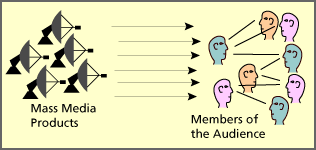 than the media manipulating the audience. This model is popular with pluralists as well as postmodernist particularly in the creation of identity.
Before we venture in to the complexities of marriage and divorce it’s worth spending some time watching this simple yet insightful perspective of the intricacies of family life.
With a third of British children living with only one biological parent, this simple but revealing film ventures into the heart of British family life to ask young people about their experience of their parents’ breakup.
Based entirely on honest, intimate interviews with both young people and their parents (often sat together and discussing the event for the first time), director Olly Lambert draws out the complex feelings and secrets that took root in the family when mum and dad split up.
In the process, both parents and their offspring find themselves asking questions of each other that have remained unsaid for years, and being frequently surprised by the answers. A moving and surprisingly uplifting insight into the reality of modern family life.
These links take you to a number of free university sociology courses. These are useful as complete courses for you to work through or as a means of extending your sociological knowledge and understanding….
Open University – What do we mean by the family?
Yale University – Social Theory
Get free live media from a range of global news outlets. Use these sociological resources to keep up-to-date with what’s occurring around the world as well as for those of you researching media sociology….
UK News
Global News
Below, we’ve a collection of Youtube sociology, which is a great place to enrich your sociological knowledge and understanding whether you’re studying A level or undergraduate sociology….
The United Kingdom is an electoral democracy. Each of the members of the House of Commons, the dominant lower chamber of the bicameral Parliament, is elected in a single-member district. This procedure multiplies the power of the two largest parties—the Labour Party and the Conservative Party—at the expense of smaller parties.
The Liberal Democrats, the third-largest party, are the most disadvantaged; although they won 23% of the vote in the 2010 elections, they received only 8.8% of the seats in the House of Commons. The parliamentary opposition holds ministers accountable in debates that are widely covered in the press. Parliamentary elections must be held at least every five years.
How democratic is this process, the following video explains.
In addition to the Labour and Conservative parties and the left-leaning Liberal Democrats, other parties include the Welsh nationalist Plaid Cymru and the Scottish National Party. In Northern Ireland, the main Catholic and republican parties are Sinn Fein and the Social Democratic and Labour Party, while the leading Protestant and unionist parties are the Ulster Unionist Party and the DUP.
After a period of centralization under Conservative governments from 1979 to 1997, the Labour Party delivered a far-reaching devolution of power to Northern Ireland, Scotland, and Wales. The first elections to the Scottish Parliament and the Welsh Assembly were held in 1999. The Scottish body has more power, including some tax-raising authority, than its Welsh counterpart. Welsh nationalism is primarily cultural. The Northern Ireland Assembly was restored in 2007.
 sociologytwynham.com