
Below are a number of links explain the ideological shifts within the mainstream UK political parties.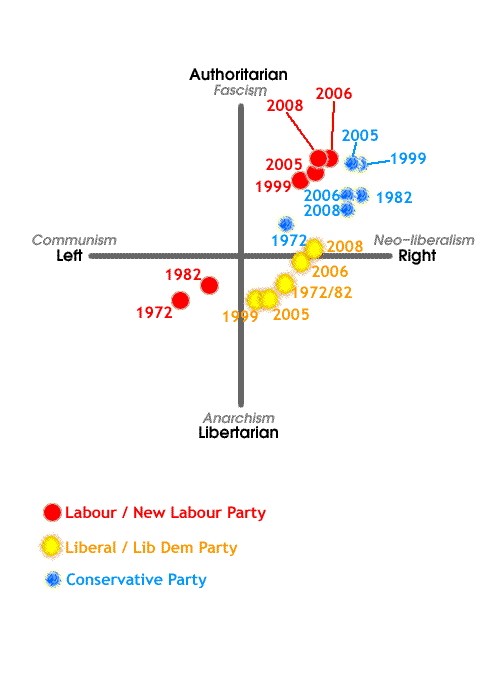
http://www.sociology.org.uk/revgpp4.pdf
http://www.theguardian.com/business/2013/oct/06/what-1973-today-economic-crisis?CMP=twt_gu
http://www.politicalcompass.org/ukparties2010

Neo-Marxists’ develop the traditional Marxist view of media ownership by arguing media owners don’t have direct but indirect control of influence on media content. This indirect influence is more subtle as any ruling-class ideology is shared by the journalists and media managers – this process fits well with Lukes 3rd face of power. By already sharing ruling-class ideological values, neo-Marxists argue the media is able to establish a dominant ideology (hegemony) over issues. Some sociologists have researched how this media power helps establish a moral panic over selected issues by initiating a deviancy amplification spiral.
Neo-Marxists identify several key features:
- owners don’t get actively involved in controlling content on a day-to-day basis. Instead control and content is left in the hands of journalists and managers
- as managers and journalists want to protect their jobs they seek to attract advertisers and audiences by publishing suitable content. Sometimes audiences are attracted by media criticism of ruling-class, but such criticism is never threatening or damaging
- journalists and managers don’t tend to criticise dominant ideology because of their background. Journalists tend to be white, well-educated, middle-class and male therefore they’ve already been socialised to accept and value the ruling-class ideology, thus their media messages tend to support the established social consensus
- this common-sense consensus is promoted within the range of view and opinions transmitted in media products
- the cultural effects model best explains this effect on audiences
The traditional Marxist approach argues the concentration of ownership of the mass media in the hands of a few corporations enables owners to control media output and send out ideas/ideologies which benefit ruling-class interests. This approach sees the media as an instrument of the ruling-class. Marxists identify several key features to their approach:
- owners have direct control of media content
- owners can and do interfere with media content
- owners use the media to spread ideas (dominant ideology) which justify the position and power of the ruling-class
- media managers have to follow the wishes of their owners
- journalists depend on owners for their jobs so are unlikely to run stories which challenge the status and authority of the ruling-class

- audience is assumed to be passive who consume media messages without thought – hypodermic syringe model best explains audience behaviour

Weaknesses
- pluralists argue there’s a wide range of media with differing views
- state regulates media ownership so companies don’t dominate
- audiences aren’t passive and actively challenge what they’re informed about – eg Twitter
Return to power and politics overview
Unlike Marxists and neo-Marxists pluralists suggest there is no dominant ruling-class but numerous competing groups with different interests. The owners do not directly control the content of the media, but rather what appears in the media is driven by the wishes of consumers. Audiences watch what they want to and do not watch what doesn’t reflect their interests. Pluralists identify the following points: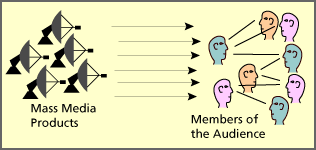
- owners do not have direct control over media content
- there’s no dominant class but competing social groups
- media content isn’t ideological neither does it reflect the interests of owners
- media content is driven by media managers who give journalists the freedom to seek out any type of newsworthy story
- media content is their to meet the needs of its audience as the audience choose the content they wish to read or watch
- any bias is merely reflects audience interests as the audience ultimately has the final say it what he or she wishes to view
- uses and gratification model best explains this process
Norm-setting describes the way the mass media reinforces conformity to social norms and social alienates those that don’t conform. This conformity can be demonstrated in distinct ways:
- advertising reinforces gender roles
- through the use of language in news reports – workers who refuse to strike are brave while those that strike aren’t
- discourages non-conformist behaviour by sensationalising certain types of behaviour in programmes like Nick and Margaret: We All Pay Your Benefits
In many ways gate-keeping sits alongside agenda-setting. While agenda-setting is the media industry’s influence over issues being discussed, gate-keeping is the media’s subtle refusal to discuss certain issues or topics.
This is particularly evident in the way strikes or industrial disputes are reported. The Glasgow University Media Group researched the way media reports on strikes tend to be unfavourable therefore ‘gate-keeping’ any favourable reporting on strikes.
Similarly reports on welfare-claims tend to detail the benefits gained by welfare claimants while issues surround low pay and the need for a living-wage are kept at the media gates.
Agenda setting is the idea the media have a powerful influence over the issues that people think about because the agenda is already set by journalists. This is because people can only discuss and form views about the issues they’ve been informed about.
The power journalists and others working in newsrooms have in society is clearly extensive. By having the ability to set the agenda, journalists decide the main topics of discussion for people in society. This can mean the public never discuss some subjects because they are not aware they’re on the agenda for discussion. Bachrach and Baratz termed the prevention of issues getting on to the agenda as non-decision making (what Stephen Lukes termed the 2nd face of power).
As mass media companies are business, their main aim is to make money. Though newspaper’s make money from selling their product, a significant proportion comes from selling advertising space.
It is newspapers dependence on advertising revenue which drives their sales towards a particular ‘target’ audience. Advertisers will usually only advertise if their product is reaching enough of the ‘correct’ type of audience. This explains why circulation figures are important to advertisers, as well as advertisers wanting to know the social-class of a newspaper’s readership.
A manufacturer is unlikely to want to advertise a very expensive car in a newspaper whose readership is predominantly working-class. This same principle is applied to television shows, magazines etc.
The significance of this process for sociologists is to what extent do media outlets ‘steer’ content towards issues which make them more attractive to advertisers.
 sociologytwynham.com