

Points to consider when looking at above map. However before you start to answer these questions you need to make certain your subject knowledge is extensive enough. Therefore test yourself here Knowledge test 10/11/12 Knowledge test 12/11/12
1. How might culture shape our identity?
2. Are we free to construct our own identity?
3. What has the largest influence on UK culture?

Points to consider when looking at above map
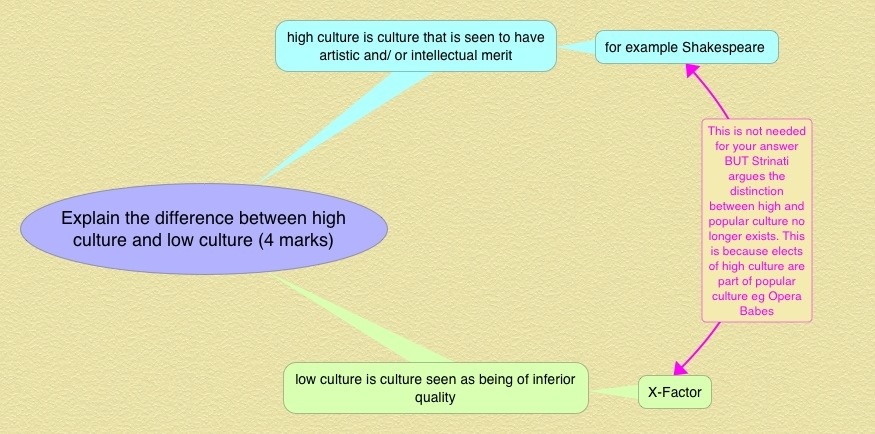
1. What dominates the dominant culture – high or low cultural products?
2. Is globalisation eroding high culture?
3. Does Strinati have a point?
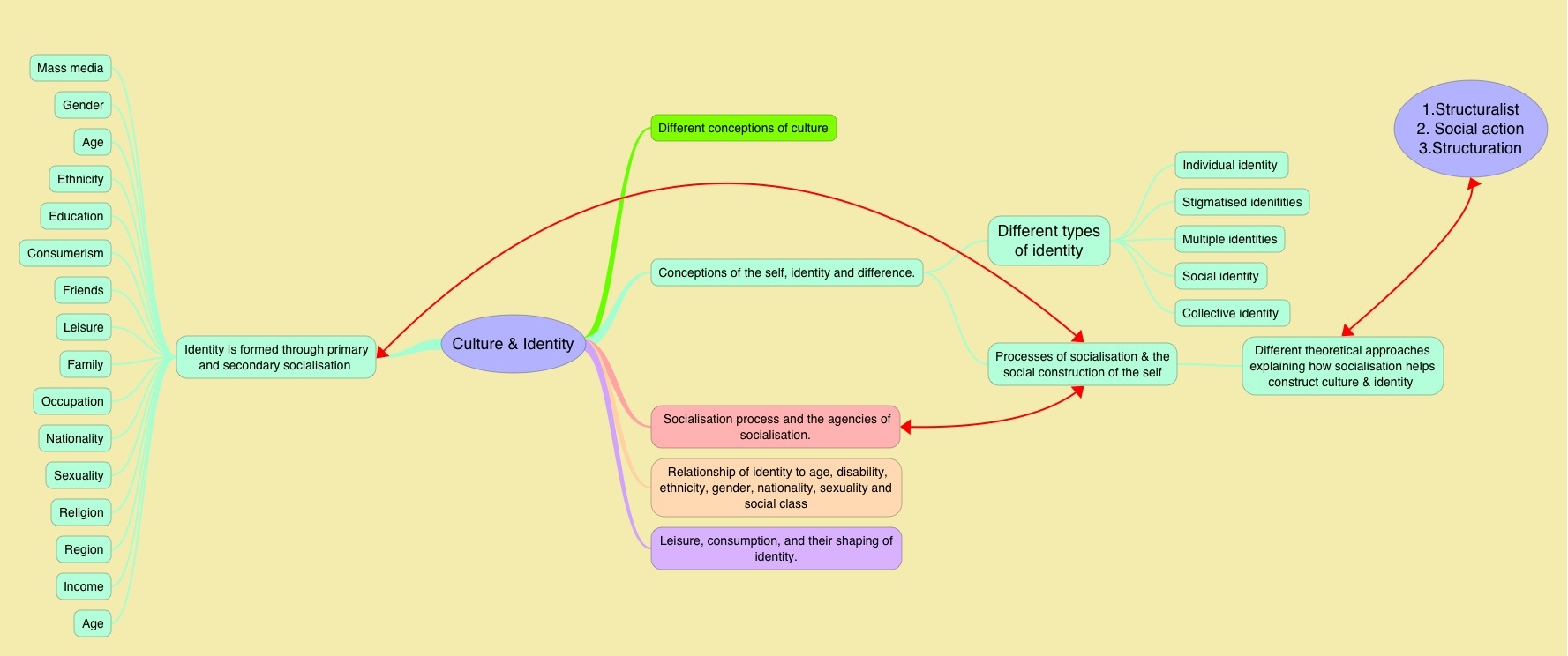
Points to consider when looking at the above map
1. Which has the greater influence in the formation of identity, primary or secondary socialisation?
2. Which has the greater influence in the formation of identity gender, occupation, friends or mass media?
3.Which is the more powerful in the formation of identity, free-will or social structures?
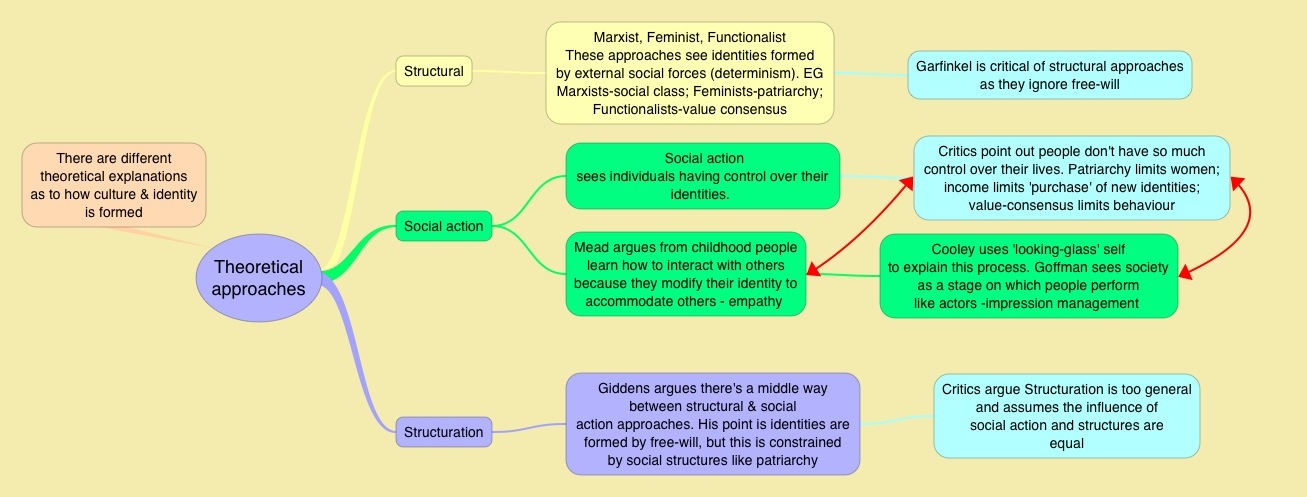

Points to consider when looking at the above map
1. Which theoretical approach best fits with postmodern view of identity?
2. For Strinati what role does high culture have in the creation of identity?
3. What do postmodernists ignore in their model of a ‘purchased’ identity?
4.What’s the relationship between ‘images of aspiration’ and globalisation?
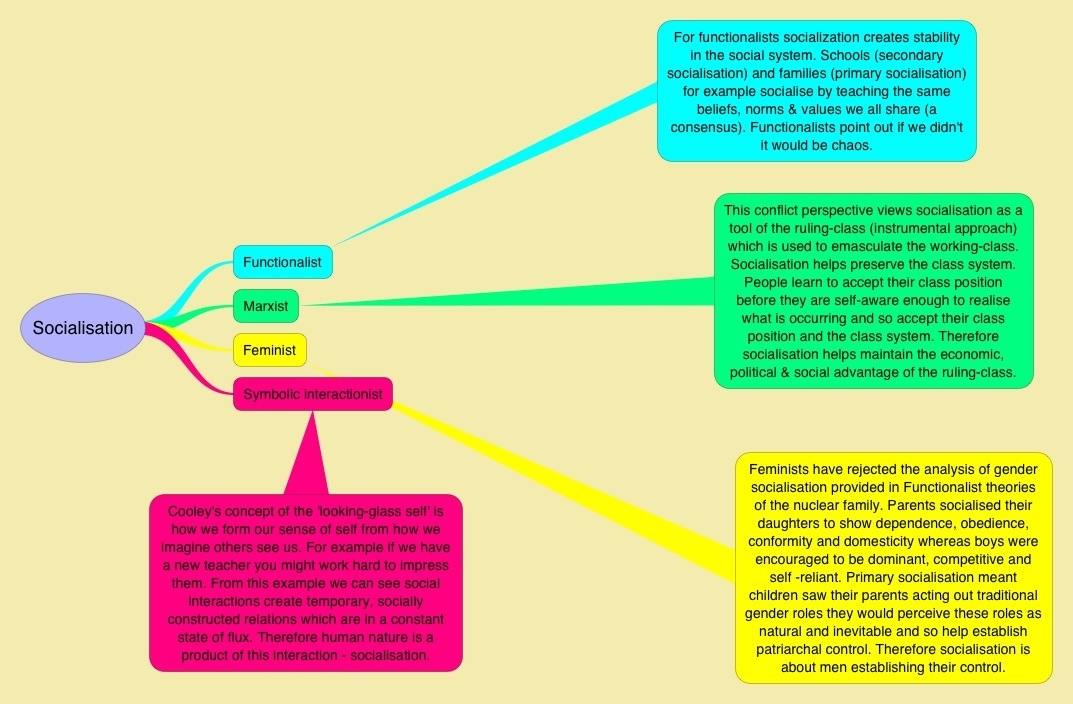
Points to consider when looking at the above map
1. The different views on the role of socialisation.
2. Which perspectives see the role of socialisation as being a negative?

The above diagram highlights the role of the media in socialisation. The extent to which socialisation is important in creating identity is made clearer in the image below. This image also highlights the importance in using key sociological concepts as explanatory tools.

The image below looks at the role of socialisation in forming sexual identity.

Socialisation plays a massive part in defining the identity of disability.

The image below highlights one way of analysing the concept of master-status by using other concepts to explain your thinking.


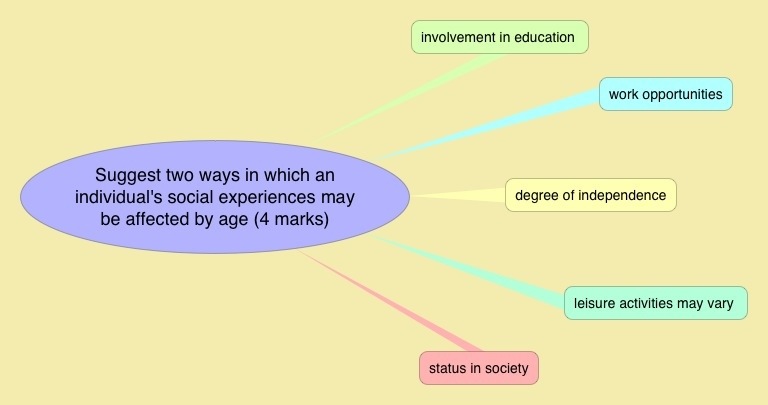

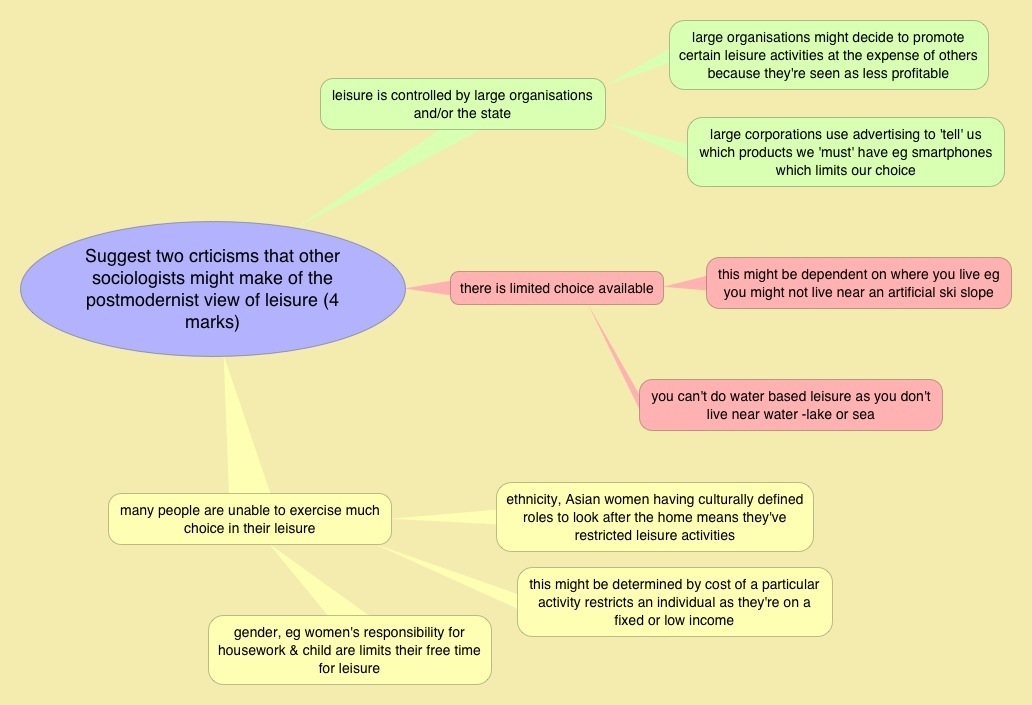
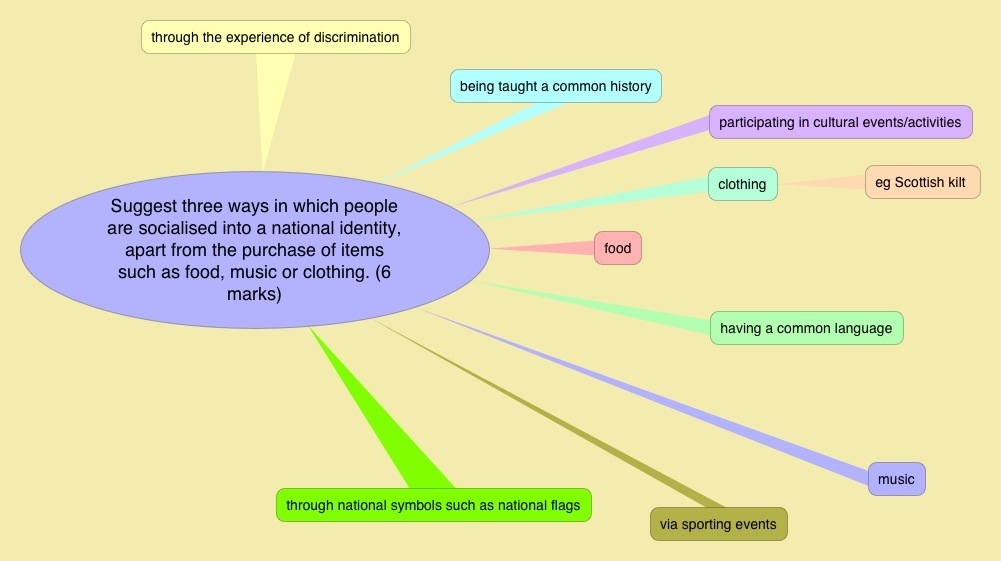

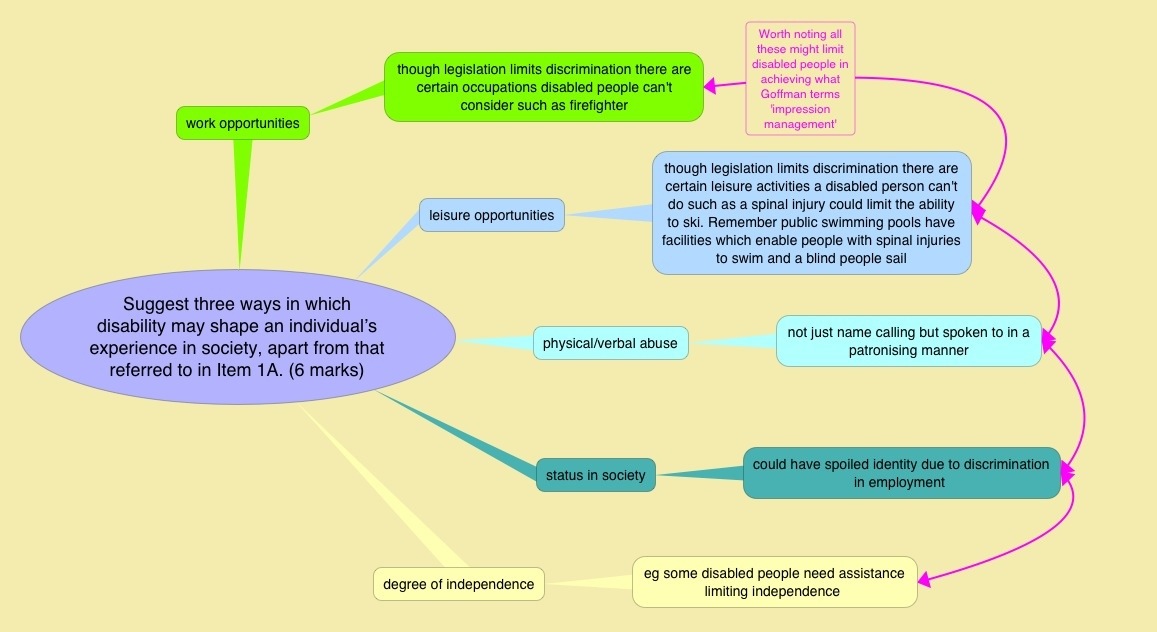




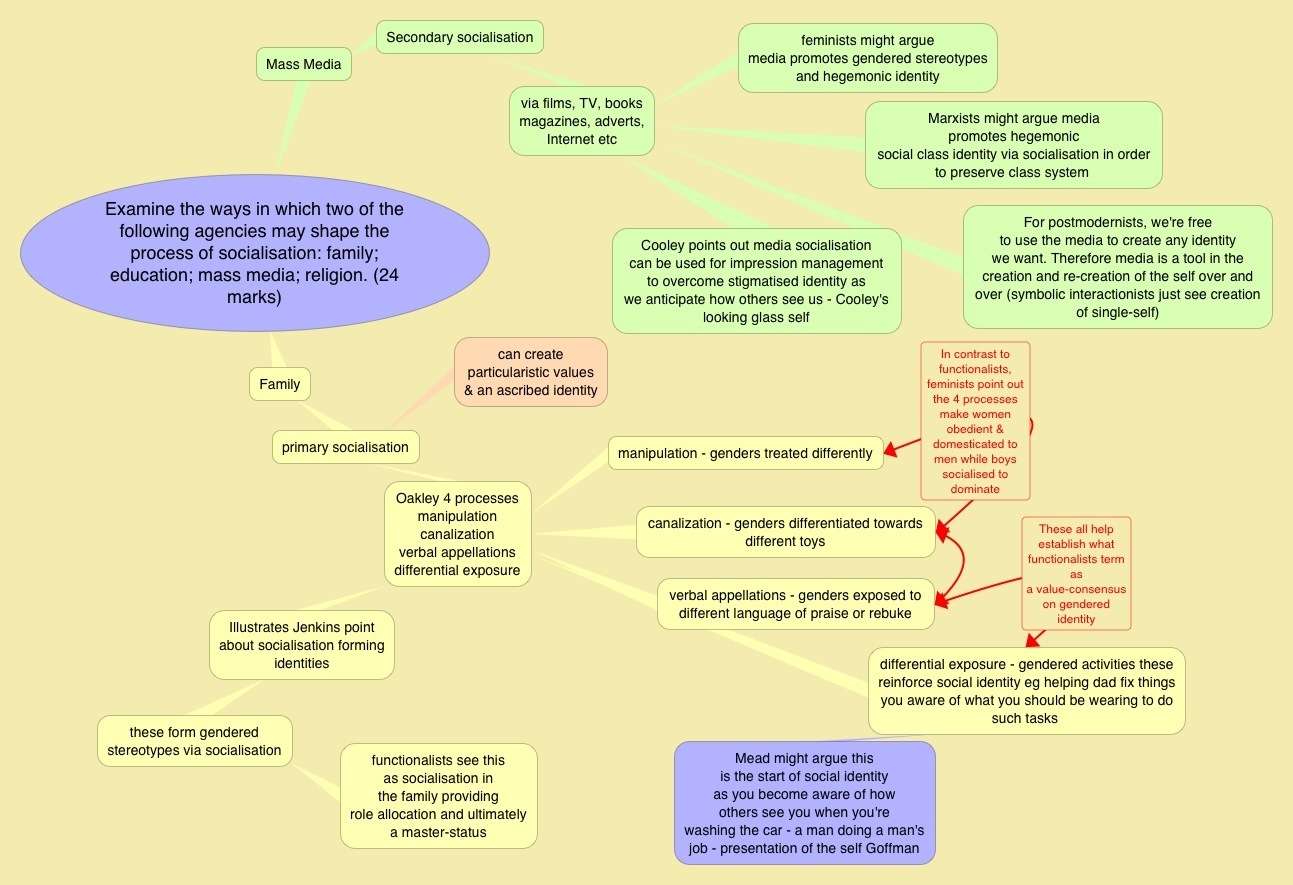

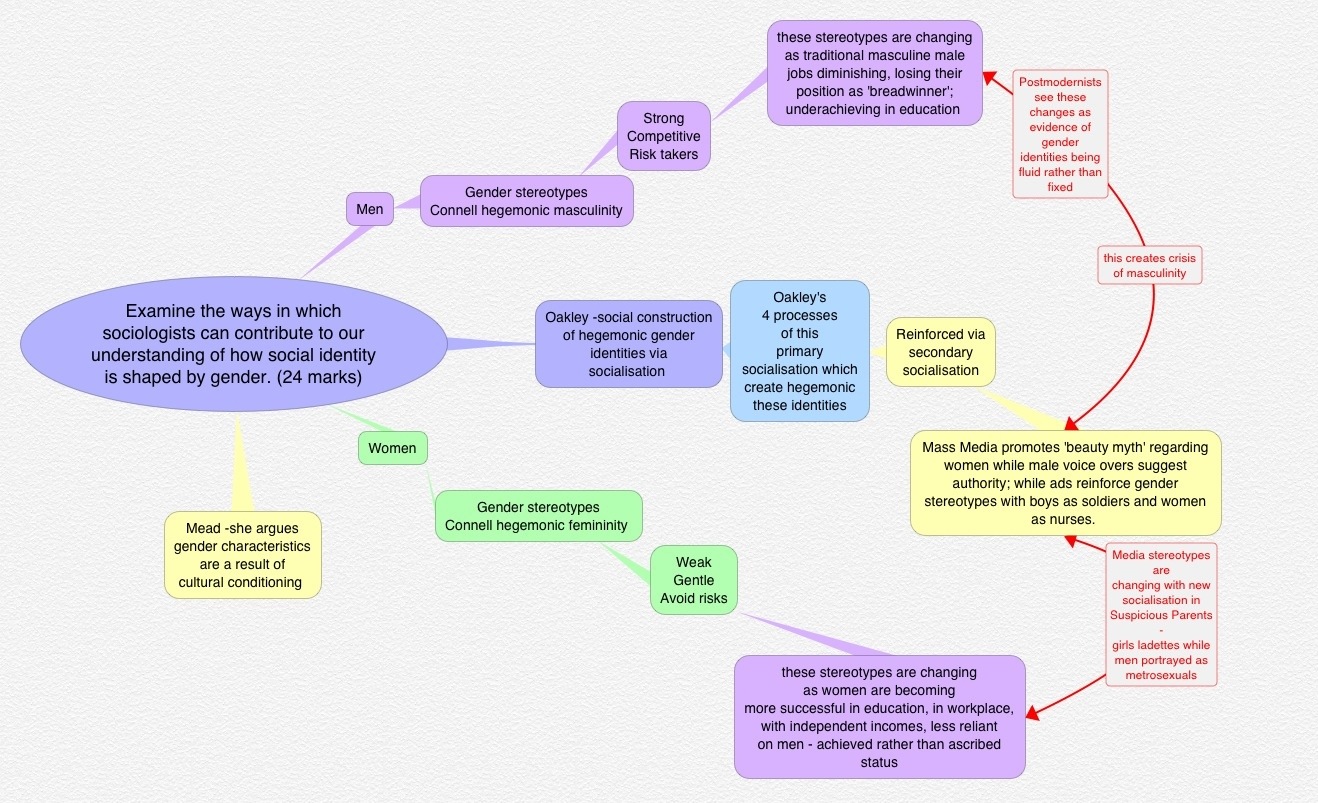


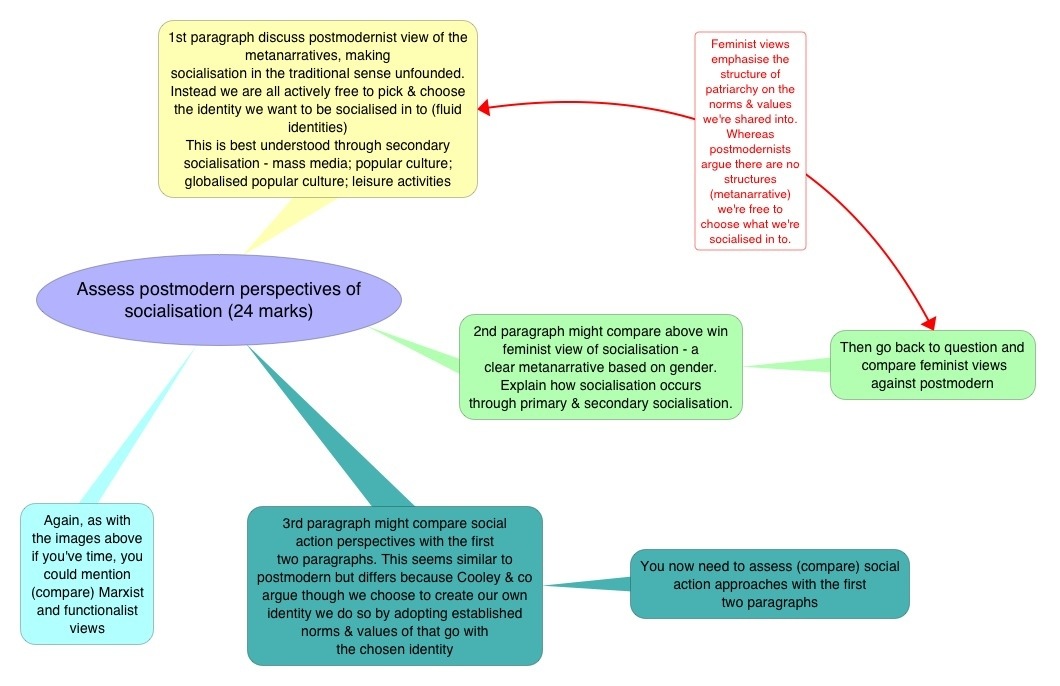
This images examines the competing sociological perspectives on the role of education in society.

Points to consider when studying the image above:
1. What are the strengths and weaknesses of each perspective?
2. How does the role of the hidden curriculum differ between each perspective?
3. In what way does each perspective see the function of education as being?
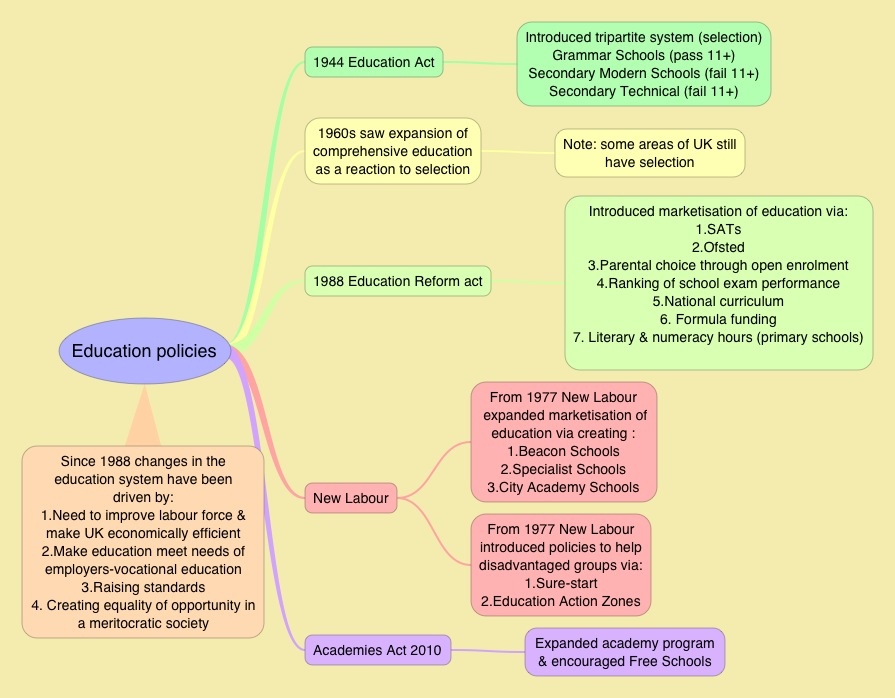
Points to consider when studying the image above
1. What are the benefits/problems when schools select by ability?
2. What are the advantages/disadvantages with comprehensive schooling?
3. What are the strengths/weaknesses using market forces in the education system?

Points to consider when studying the image above
1. When examining factors outside school, which would you argue is the most useful in understanding attainment at school
2. When examining factors inside school, which would you argue is the most useful in understanding attainment at school?
3. Assess whether factors inside or outside school are the most influential in understanding attainment at school?


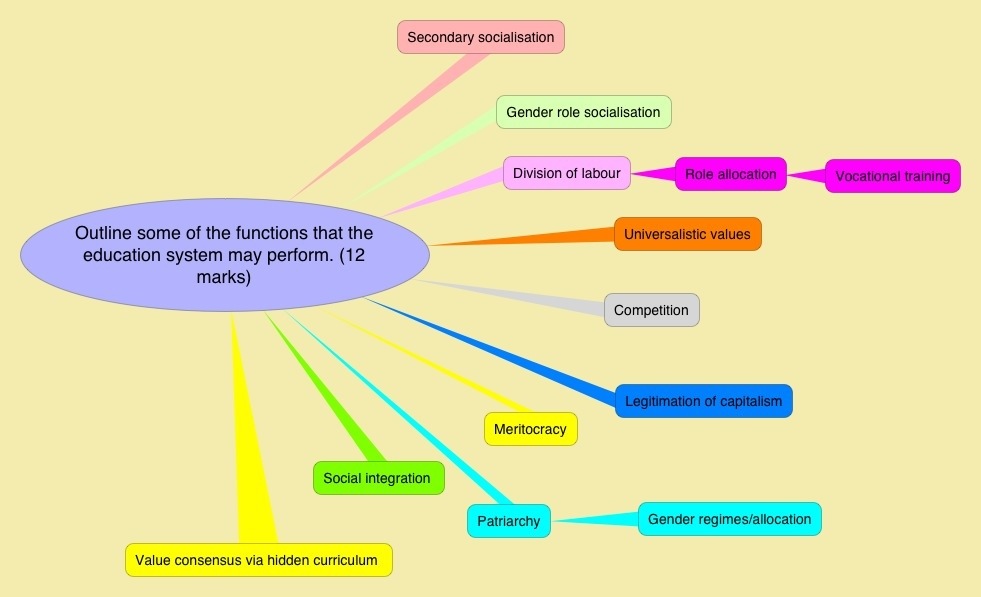
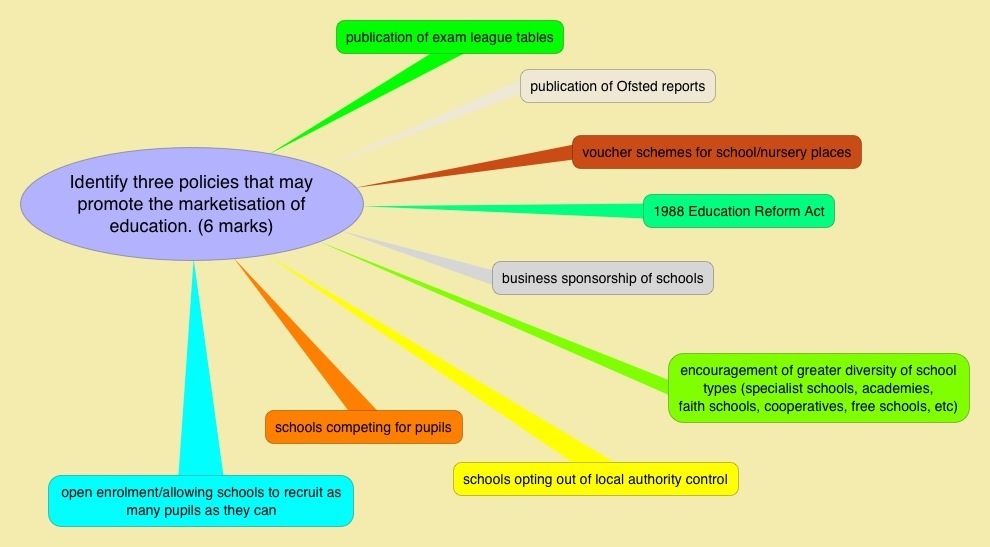
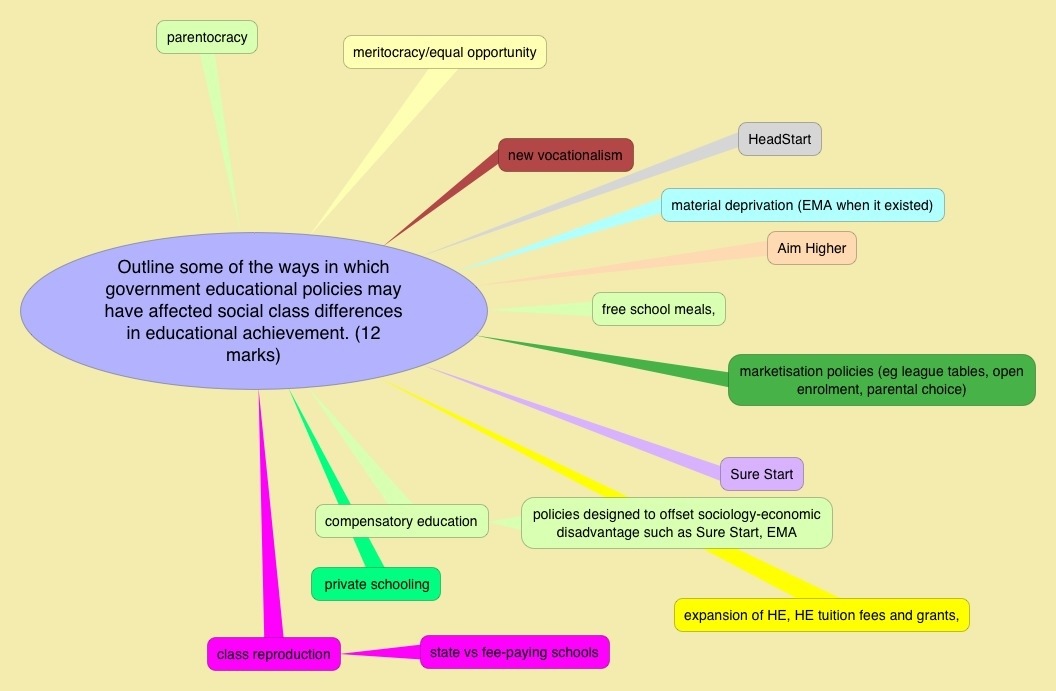
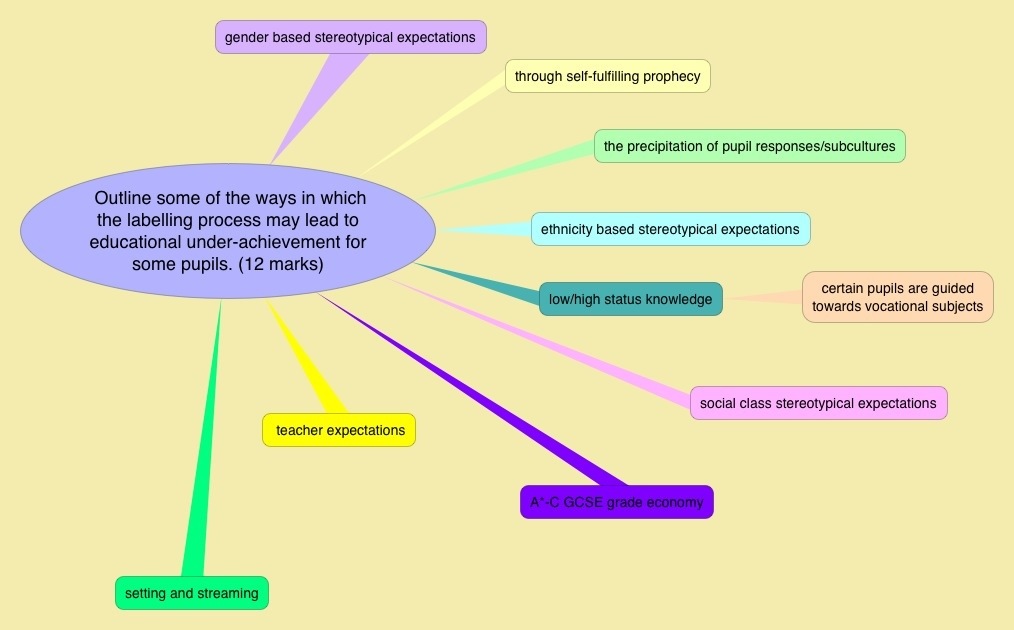
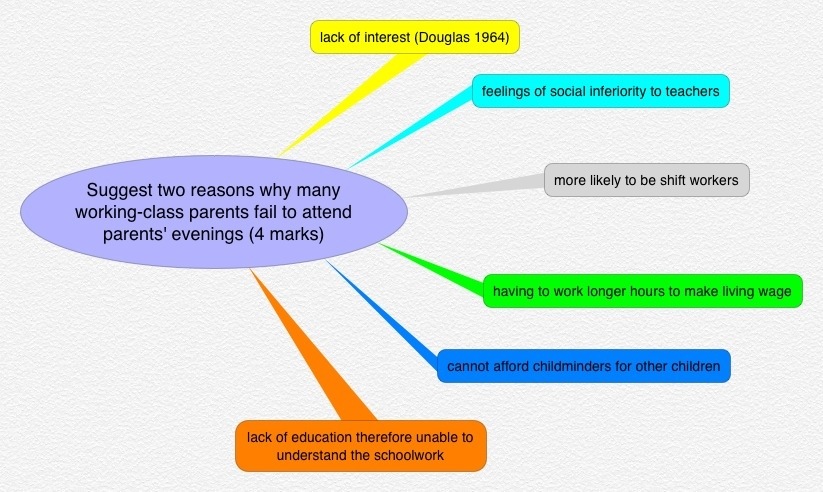
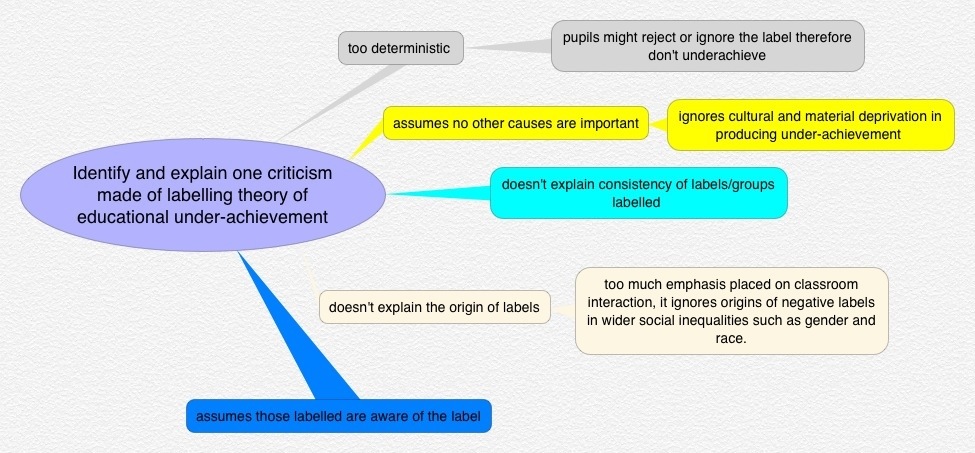
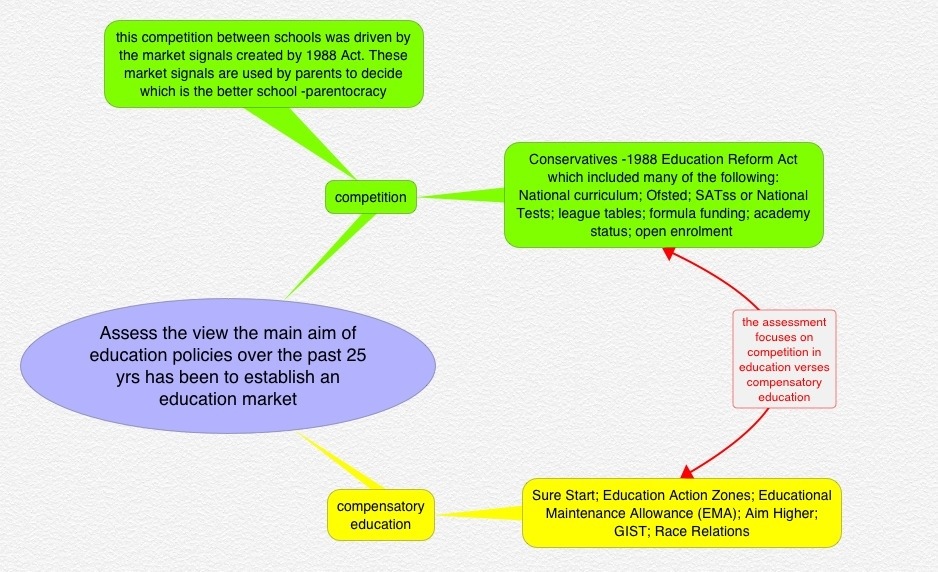
Some past questions have been worked through below















Realist criminology (whether left or right realist) are a response to a perceived intensity in the public’s fear of crime. Therefore realist perspectives concentrate on crimes which the public tend to fear most such as street crime, mugging, violence etc., rather than crimes of the powerful (as Marxist’s do). In essence realist criminology is saying to feminist, Marxist etc., ‘get real’ your ideas are too abstract.
This shift came mainly from ‘law and order’ issue becoming an ever increasing concern to politicians such as Thatcher. Much of this increased concern came from the expansion of gathering crime data in the 1980s particularly the introduction of the British Crime Survey (Mike Maguire, 2005). Within this context police powers were extended, along with tougher sentencing and imprisonment options being given to the courts.
New ’realist’ criminologists such as Wilson moved away from liberal ideas of rehabilitation towards tougher punitive measures aimed at punishing evil or wicked people thus deterring these people from ever offending again. However left-realist criminology emerged as a reaction to the right-realist political climate but also they were reacting the idealism of Marxist and neo-Marxist perspectives – which is best imagined as a ‘hug-a-hoodie’ mentality, whereby society had to concern itself as much with the culprit as the victim.
The clip below describes the key aspects of left-realism. However there’s more detail you need to know.
Revision podcast Left Realist Perspective
Realist criminology (whether left or right realist) are a response to a perceived intensity in the public’s fear of crime. Therefore realist perspectives concentrate on crimes which the public tend to fear most such as street crime, mugging, violence etc., rather than crimes of the powerful (as Marxist’s do). In essence realist criminology is saying to feminist, Marxist etc., ‘get real’ your ideas are too abstract.
This shift came mainly from ‘law and order’ issue becoming an ever increasing concern to politicians such as Thatcher. Much of this increased concern came from the expansion of gathering crime data in the 1980s particularly the introduction of the British Crime Survey (Mike Maguire, 2005). Within this context police powers were extended, along with tougher sentencing and imprisonment options being given to the courts.
New ‘realist’ criminologists such as Wilson moved away from liberal ideas of rehabilitation towards tougher punitive measures aimed at punishing evil or wicked people thus deterring these people from ever offending again. In essence right realism moved away from social theories of crime towards more explanations centred around the individual.
Revision podcasts Right Realist Perspective
The two clips on this page help provide a context for the rise of feminism.
Feminist perspectives moved the emphasis of criminology towards issues of gender. Their approach examines the relationship between gender and offending which is explained first-hand by Vicky Pryce’s experience in HMP Holloway.
What are the basics of the feminist theory of crime?
The feminist theory of crime argues that society is patriarchal and the control of women by men discourages female deviance. Sociologists in the past have paid little attention to female deviance, instead tending to focus on male deviance. Feminists also point out that female victimization was ignored due to the invisibility of women, identified by Newborn. The feminist view is that male dominance in society was reflected in mainstream theories of crime, known as ‘malestream’ sociology.
The exam question you are given can either be asking why males are offending more than females (in which case you would wrote about male offending), or it can be asking why females offend less than males (in which case you would write about female offending).
The statistics of gender and crime
- In 2012/13, the arrests were 15% female, and 85% male.
- The prison population in June 2014 was 5% female and 95% male, and in the last 10 years, the male prison population has increased while the female population has decreased.
- 1 in 3 males and fewer than 1 in 10 females are likely to have a conviction of some kind by their 40th birthday.
Sex role theory – (this is an early, androcentric, sociological theory which attempts to explain gender differences in crime – it’s not a feminist theory) argues that because boys and girls are socialised differently boys are more likely to become criminal than girls. Sutherland (1949) identifies how girls are socialised in a manner which is far more supervisory and controlled, this limits the number of ‘opportunities’ to be deviant.
In contrast boys are socialised to be rougher, tougher and aggressive which makes deviancy more likely. Albert Cohen (the subcultural theorist) identified socialisation as a difficult time for boys, especially if there wasn’t a male role model in their lives-in 2013 this perspective was resurrected -which can lead to boys joining gangs in order to establish their masculinity.
The above reasons were used to explain the low incidence of women in official crime statistics and subsequently in criminological studies. In contrast Feminists such as Smart (1977) gave the following reasons for the low incidence of women in criminology (the study of crime).
- Official figures show women simply do commit fewer crimes
- Most crimes committed by women are trivial
- Sociology is dominated by men (malestream effect)
Other feminists writers developed Smart’s point with the ‘chivalry’ factor: Campbell’s (1981) self-report study (self-report studies use questionnaires & interviews) found that
- Female suspects were more likely to receive a caution than men who’d be prosecuted
- The rate of male to female juvenile offending was higher (girls committed more offences) than official figures indicated
Hood (1989) also found evidence of the chivalry factor when comparing the sentencing of men and women – found men were more likely to be given custodial sentences (prison) than women. BUT – as with all things there’s opposing evidence to the ‘chivalry’ factor:
- Box (1981) reviewed self-report data and said the findings were the same as official figures
- Farrington and Morris (1983) research found that though men do receive harsher sentences than women, this distinctions shrinks in relation to the severity of the offence committed
- Walklate (1995) research found female rape victims are face a tough rather than chivalrous court system as there’s an inevitability in the system which forces women to prove their respectability before they are believed
- Heidensohn (1985) sees the legal system as seeing convicted women as being doubly deviant and therefore get tougher sentences than men
- Smart (1997) argues the criminal justice system first views women through the lens of their track record of being a mother, wife and daughter
Causes of female crime and deviance are varied:
- Lombrso (1895) – (he wasn’t a feminist) viewed women as having less physiological characteristics of the usual male criminal
- Adler (1975) – said women’s liberation had created more criminals as women were adopting more male characteristics as a means of fulfilling male social roles – just thinking of the rise of ‘ladette’
- Box and Hale questioned Adler arguing the increase of female criminality is more likely do to inadequate welfare, unemployment and part-time work as most female criminals are from a working-class background
The above points are developed further by social conformity. Hiedensohn (1985) said: patriarchal societies control women far more than men by controlling women:
- women at home – do all the caring, cooking and cleaning
- women in public – can’t go out socially like men as labelled as ‘slags’
- women at work – controlled by male superiors
Masculinity and crime – Messerschmidt argues:
- middle-class boys behaviour in school is so good they repress their true selves and so commit deviant acts outside school such as drinking, speeding etc as a form of emasculation
- working-class boys having less chance of achieving at school and so act tough in school with teachers etc
Revision podcasts Feminist Perspectives
Neo-Marxist perspectives of crime differ to Marxist approaches. As discovered previously, Marxist’s expanded criminology by moving away from discussing what crime and deviance was to exploring the power of some social groups to criminalise.
Taylor et al : ‘The New Criminology’
- The starting point of Taylor et al’s ‘New Criminology’ is a rejection of the traditional Marxist view that workers are driven to crime by economic necessity. Instead, they believe that crime is a voluntary act. In particular they argue that crime often has a political motive, for example, to redistribute wealth from the rich to the poor. Criminals are not passive puppets whose behaviour is shaped by the nature of capitalism. Instead they are deliberately striving to change capitalism.
- Taylor et al are trying to create what they call a ‘fully social theory of deviance’ which has two main sources:
- Traditional Marxist ideas about the unequal distribution of wealth and who has the power to make and enforce the law.
- Ideas from interactionism and labelling theory about the meaning of the deviant act for the deviant, societal reactions to it, and the effects of the deviant label on the individual.
- In their view, a fully social theory of deviance needs to bring together six aspects:
- The wider origins of the deviant act in the unequal distribution of wealth and power in capitalist society
- The immediate origins of the deviant act – the particular context in which the act takes place
- The act itself and its meaning for the individual – e.g. was it a form of rebellion against capitalism ?
- The immediate origins of the social reaction – the reactions of those around the deviant, such as the police, family and community, to discovering the deviance.
- The wider origins of the social reaction in the structure of capitalist society – especially the issue of who has the power to define actions as deviant and to label others, and why some acts are treated more harshly than others.
- The effects of labelling on the deviants future actions – e.g. why does labelling lead to deviance amplification in some cases but not in others ?
For Taylor et al, these six aspects are interrelated and need to be understood as part of a single theory. Using points 2, 3 and 6 above we can better understand Stuart Hall and Paul Gilroy’s neo-Marxist view of crime and deviance.
- Stuart Hall’s ‘Policing the Crisis’ is a study of a moral panic over ‘mugging’ in the 1970s
- In the 1970s a moral panic over mugging happened in Britain
- Mugging is a concept which was imported from the US in the 1970s and tended to refer to being robbed by black men
- During the 1970s several newspapers repeatedly reported incidents of mugging
- This moral panic was built upon the idea of a collective fear of an ‘enemy within’
- Stuart Hall’s ‘full social theory of deviance’ looked at the idea of the Black mugger as a scapegoat for other social ills of the period
- Wave after wave of strike action brought about civil unrest and the subsequent challenge to social order and the power of the state
- Stuart Hall’s point is by making the Black mugger someone to fear, it solidified a fractured UK society around the state
- Subsequently society allowed the state to randomly stop and search Black youths
- This labelling of Black youths led to a process of deviancy amplification
- Therefore Hall’s idea are more comprehensive as they merge labelling, societal reaction, moral panics and deviancy amplification into a complete ‘social theory of deviance’ as pointed out by Taylor et al
Paul Gilroy took up this social theory of deviance in his book ‘There ain’t no black in the Union Jack’
- Another example is Paul Gilroy’s: ‘There Ain’t no Black in the Union Jack’
- Gilroy rejected the view that Blacks’ resorted to crime due to poor socialisation, he said it was a result of ethnic minorities defending themselves against an unjust society
- Gilroy saw the resultant riots in Toxteth and Southall in 1981 as political acts – this links well to Taylor et al’s point 3 above
- The riots did remove of the ‘sus’ laws brought in by 1970s ‘muggings
Evaluation
(+) Attempts to be less deterministic by giving criminals the choice of free will
(+) Considers interactionist ideas and looks into the meanings of criminal acts
(+) It is less reductionist as it looks at the full picture of crime
(-) Realists say that this approach romanticises working-class crime as being commit by ‘robin hood’ like heroes
(-) The working class commit crime against themselves and not just against the ruling class
(-) It’s not mentioned crime that has been committed with a political motive
(-) The theory has over-emphasised class inequality
(-) Feminists argue that the theory is ‘gender blind’ by only focusing on crimes committed by men
Revision podcast Neo-Marxist Perspective
Marxists effectively developed labelling theory so it would recognise the social and political structures in which labels are created and adhered. In a sense Marxists appreciated the logic of labelling particularly as it examined the processes through which deviance is defined, secured and sanctioned.
However for Marxists labelling theory failed to account for why some behaviours were defined as deviant and other not. Instead Marxists looked at how certain social groups achieved the power to apply labels to certain acts and whether or not these same social groups were having ‘their own’ law and order protected.
It’s easier to understand Marxist perspectives of crime, if you fully grasp the Marxist social theory (in fact it’s easier to understand all the perspectives of crime this way). For Marxists all social phenomena are explainable through society’s means of production. Our capitalist means of production mean those who own the means of production have structural control over those who don’t. This causes social inequality and social conflict.
Marxist views of crime are best understood has having three distinct elements or processes :
- Criminogenic capitalism
- The role of the state and law making
- Selective enforcement
Criminogenic capitalism: Bonger (1916) was the first to apply notions of social conflict to the subject of crime and here’s a few of his central themes:
- Criminal law exists to protect the interests of the powerful
- The dynamics of capitalism encourages egoism and greed which in turn motivates both the working and ruling-classes are prone to crime as they don’t care about each other
- Poverty prompts crime to the extent it creates a desperate need for food and other necessities
The role of the state and law making: sixty years later Chambliss’ Marxist perspective on crime moved Bongor’s points forward by concentrating on the role of the economic production on social relations (including crime):
- the ruling-class will violate laws with impunity while members of the subject class will be punished
- acts are defined as criminal because it’s in the interests of the ruling-class to define them so
- crime will persist in capitalist societies because such societies promote inequalities, class-conflict and penal laws expand accordingly
Selective enforcement: Spitzer (1975) argues deviants and criminals are ‘constructed’ when certain groups (working-class) create problems those who rule. Therefore any person who calls into question the social conditions under which capitalist production takes place are likely to find themselves subjected to a process of criminalisation.
In contrast to positivism, interactionism presents a view of the world which emphasizes the role of human agency as opposed to the deterministic view of functionalist, subcultural and biological explanations. Rather than viewing human behaviour as determined by external forces, Mead argues ‘the self’ is a social construct and the way others see and react to them is part of the way we construct ourselves.
For interactionists deviance is no longer a pathological act going against consensual norms but something created in the process of social interaction, in which some people who commit deviant acts come to be known as criminals while others do not. So instead of asking behavioural questions like “who is deviant?”, “why do they do it?” and “how might they be best controlled?” interactionsists ask “who defines another as deviant?”, “how does a person react to their label?”
Becker’s idea of labelling came to the fore in the early 1960s and it was a very new approach. Becker said: “social groups create deviance by making rules whose infraction constitutes deviance and by applying those rules to particular and labelling them as deviant.”
Labelling is an active social process of how particular acts become defined as deviant. Therefore deviance isn’t an absolute category but a relative one as certain acts are defined as criminal at certain times and others aren’t. Becker illustrated his point “injecting heroin into your arm is not deviant, because it’s fine if a nurse does it under doctors orders. It only becomes deviant when society defines it as such”
In this process the agents of social control (police, judiciary, probation service etc) define who and what is deviant. Labelling theory illustrates the way police target specific social groups. For example ethnic minorities or working-class youths living in specific areas are targeted more by the police – Reiner (1994). While Cicourel’s (1976) study of police & juvenile officers in California found police were more likely to arrest people who fitted the picture of having – poor school performance; low-income backgrounds; ethnic minority membership. In contrast Cicourel found middle-class delinquents who were arrested tended to be counselled, cautioned and released by police officers.
Labelling theory shows how authority figures have the ability to create the social characteristics of typical delinquents as being – young, working-class and male. This contrasts significantly with functionalist/subcultural notions of crime & deviance as being located in pathological individuals.
Lemert moved interactionism forward by arguing there’s a difference between primary and secondary deviance. Primary deviance are acts which haven’t been publicly defined as deviant, mainly because they’re isolated and fairly insignificant cases of rule-braking. While in contrast secondary deviance the construction (making) of deviance through social reaction to the rule-breaking.
Therefore this two stage process shows how deviance is a process. First it’s identified and then agents of society gets involved in ‘creating’ the deviance (this shows how labelling causes deviance). This had the effect of turning the previous perspectives on their head!! This is because deviance is not a universal or constant idea but one relative to the society. This simply means that for example it’s not deviant to wear Speedo’s in the swimming baths in France (you’re not allowed to wear anything but Speedo’s) but it’s become odd (maybe deviant to wear Speedo’s in UK swimming baths!


Revision podcast Interactionist Perspective
The slideshow below explains the social theory behind interactionism and labelling. In other words symbolic interactionism came first, then Becker etc used the theory to support their perspective on crime!
The theory of anomie as proposed by Durkheim and Merton subsequently provided the building blocks for the development of subcultural theories of delinquent and criminal behaviour. Albert Cohen’s argued Merton’s 5 modes of adaptations failed to account for non-utilitarian crimes, as many delinquents were involved in petty crimes, as opposed achieving material successes. For Cohen the subculture of the gang was a reaction to the dominance of middle-class culture which alienated and discriminated against the working-class because of their class position. In other words working-class youths were frustrated by their status – status frustration.
Status frustration becomes visible in all forms of behaviour whereby future time orientation, deferred gratification and respect for property are rejected in place of present time orientation and instant gratification (education unit). Follow this link for a deeper analysis of Cohen’s theory.
Cloward and Ohlin also saw working-class deviancy as a collective rather than an individual problem. Their version of strain theory identifies how the problem for the delinquent is to achieve a high status. They argued that a criminal subculture develops mainly in lower classes because criminal success is visible to young people who are willing to associate with these gangs. Their willingness stems from the often limited legitimate opportunities to succeed compared to the number of criminal successes. Indeed in more disruptive neighbourhoods conflict subcultures (gangs fighting) are likely to occur because there’s a lack of both legitimate and illegitimate means to succeed. They identified tree types of subcultures; criminal, conflict and retreatist. Which of these three types of subcultures were the Jets?
Miller (1958, 1959) agreed with Cohen that there was a delinquency subculture, but argued that it arose entirely from ‘focal concerns’ (the lower class way of life directed towards criminality). There was a clear distinction in values between the two social classes. Whereas the middle class ‘focal concerns’ are achievement and social goal oriented, Miller thought that lower class boys are socialised to be tough and street-smart which gave them an incentive to join a gang. Given that their ordinary lives were boring, the excitement of crime was a welcome relief, bringing a sense of autonomy to the monotony of everyday life. For the lower class the same sex peer group or gang is more important than family, work or school because it offers a sense of belonging, and a way to achieve status that they cannot easily achieve in mainstream society. The focal concerns are excitement, fate, smartness, trouble, toughness and autonomy.
Miller, Cohen’s along with Cloward & Ohlin’s argument is seen to be functionalist in nature through the concept of consensus. There’s a clear consensus of shared values between the gang members succeeding (illegitimately), which contrasts between the consensus of wider society of succeeding legitimately (school, college, university, top-job etc).
Matza questioned the extent to which behaviour is determined by social-class. Matza argued gang members were only partially committed to subcultural norms. Matza argues the delinquent doesn’t form a subculture which stands opposed to main stream norms and values (the established consensus) but instead drifts in and out of crime – delinquency and drift. This is possible because there is no consensus in society – no set of basic and core values but a plurality of behaviours which the delinquent taps into. For example many young people carry out delinquent acts such as drinking or minor vandalism. However because many of these young people have been socialised properly by their parents, when they get into trouble they apply what Matza termed as ‘techniques of neutralisation’ such as blaming the group they were in for “leading them astray” or blaming the shop keeper for selling the alcohol in the first place.
Task 3
-
What do you understand by the term ‘selection’ when referring to education?
-
Which year did the tripartite system come into effect?
-
What made grammar schools different to other types of schools?
-
Why might functionalists prefer the tripartite system?
-
Why are comprehensive schools seen as socially less divisive?
-
Explain what is meant by the term ‘marketisation’ in relation to education
-
What is the post-code lottery?
-
Identify four key policies the 1988 Education Act introduced
-
How might your social-class still affect the type of school your child goes to?
-
Examine the debate between interpretivist and positivist approaches to sociological research (you need to spend around 25 minutes writing this answer)
 sociologytwynham.com