
 Everyday thousands of news stories are made available to newsrooms. These stories can be categorised into local, national or international news. Naturally it’s impossible to report on every issues, therefore journalists select the most appropriate content. From this we can see the news is manufactured for consumption (the audience is seen as consumers) just like any other product. The challenge for journalists is to be objective in their selection of what ‘to’ and what ‘not’ to report on.
Journalistic objectivity can refer to fairness, disinterestedness, factuality, and non-partisanship, but journalists try to encompasses all of these qualities in their reporting. In contrast bias means reporting on an issue or subject in a one-sided way to the extent other points of view are ignored or misrepresented.
Political commentator Noam Chomsky discusses his book Manufacturing Consent which examines the social mechanisms which undermine objectivity in the news.
As a means of discovering whether news content is objective or biased sociologists have identified several processes which decide the content of media news.
Gerry Mooney, Senior Lecturer at the Open University has examined the way the language influences Government welfare policy, pointing to the media and politicians talk about those living in poverty.
“In some ways, the terminology and words used have changed’ says Mooney, ‘but as you did begin to dig deeper the dominant narratives show remarkable consistency with those from the past. We have, for instance, the enduring legacies of the late 19th century when there were notions of a deserving and undeserving poor. This is dressed up today as ‘strivers and skivers.’
How a problem is defined, constructed and understood says much about the policy along the lines of individual ‘fecklessness’, inadequacy and so on will lead to policies that are likely to be more punitive and that will seek to encourage more individual responsibility and less reliance on benefits.”
Mooney believes that attitudes to welfare have hardened in part because of the influence of a media that is keen to pint out the finger of blame at the individual for their own circumstances, rather than look at the wider social and cultural picture.
“It should not come as any surprise that public attitudes to welfare are becoming tougher, given almost constant drip-feed by sections of the media about ‘welfare junkies’, the ‘workless’ and so on.” says Mooney.
Matters have been made worse by a spate of what Mooney calls ‘crisis of welfare’ stories in the media. ‘These reflect some horrific cases of child abuse and abduction, domestic violence and so on, but have been used to attack ‘welfare cultures’ that are pinpointed as key contributing factors. These episodes are used to criticise working-class life which is nearly always negatively portrayed and stereotyped.”
Extract from ‘Vanishing in Society’, Open Minds, 2013.
The term medium refers to one of the means or channels of communication, information or entertainment in society such as newspapers, books, cinema, Internet, radio or television etc. Whereas media, being the plural of medium, refers to all the aforementioned channels of communication available on mass.
With the growth of digital broadcasting along with the proliferation of Internet based platforms, the media has become an enormous industry with instant news available from all over the globe.
With the vast majority of the UK population having access to television either through scheduled transmissions or on-demand platforms like iPlayer the media has become an important source of information, entertainment or general leisure activity.
Therefore the importance of the media in contemporary society can’t be underestimated as most of our views, opinions and knowledge on the world around us comes to us second-hand through a variety of media platforms. The extent of such power generates two main questions for sociologists:
- do the media deliver this knowledge objectively or is their a bias in media reporting?
- do the media stereotype certain social groups, thus stratifying one social group over another?
The following links provide you with a variety of audio links to a variety of sociological research. Such diversity highlights the breadth of the  social world sociologists continually seek to investigate.
- THE HAIRLESS BODY – it used to be a feminist faux pas but now over 99% of women regularly remove hair from their bodies. Men are doing it too, Peter Mandelsson waxes the back of his hand and sportsmen, like Gavin Henson, shave their legs. Anneke Smelik, Professor of Visual Culture at the Department of Cultural Studies, University of Nijmegen (Netherland), tells Laurie what she thinks lies behind this war on body hair.
- HOODIES – Laurie Taylor talks to criminologist Dr Jack Fawbert about a recent phenomenon and ensuing ‘moral panic’ generated by young people wearing hooded tops. What was it that made this simple piece of clothing into a symbol of fear? What was the effect of trying to ban ‘hoodies’ from public places? How did all the media attention affect the sales of hooded tops?
- COOK BOOKS and IDENTITY – new research shows that people’s choice of cook books is governed by the kinds of lifestyles or ideologies that they represent rather than by the recipes and skills imparted within; it also reveals that celebrity chefs may have less to do with a food renaissance in this country and more to do with the collapse of cooking traditions within families. Laurie Taylor discusses
celebrity cook books and Britain’s food culture with social scientist and author of the research Andrea Tonner and food critic and cultural commentator Jonathan Meades. - CULTURE AND GLOBALIZATION – a new collection of essays entitled Cultural Politics in a Global Age raises questions about globalisation and cultural identity. Henrietta Moore, Professor of Social Anthropology at the London School of Economics and co-editor the book talks about the resilience of such identity in the face of external threats, about the relative success of campaigns against globalisation and about the manner in which the opportunities provided by global communication can provide alternative centres of power and influence.
- PETS AS KIN – researchers looking into people’s support groups and family networks were surprised to find that people kept mentioning their pets; twenty three per cent of the participants put their pets as part of the network of ‘people’ who helped them out. Professor Nickie Charles is co-author of a paper My Family and Other Animals. Pets as Kin; she explains the recent findings about
the relationship between the British and their pets. - GHOSTS – Dr Owen Davies, Reader in Social History at the University of Hertfordshire, looked back over the opinion polls of the last fifty years which reveal a constant rise in the percentage of the British population that believes in ghosts. Owen became interested in finding out why popular belief in ghosts and the supernatural should fluctuate, and what social, economic and religious changes are responsible for our changing attitudes. His new book is The Haunted: A Social History of Ghosts
- BOXING – Laurie Taylor is joined by Kasia Boddy, author of Boxing: A Cultural history, and Professor Loїc Wacquant, sociologist, ethnographer and former apprentice boxer to consider the sport’s history in terms of race, class, and representation, from bare-knuckle fights to attempts to tame the Kray Twins
- GENTRIFICATION – Laurie Taylor is joined by Sophie Watson, Professor of Sociology at the Open University, Tim Butler, Head of the Department of Geography at King’s College in London, Dr Tom Slater who will soon be talking a post as Lecturer in Human Geography at the University of Edinburgh, and Lance Freeman, Assistant Professor in Urban Planning at Columbia University to discuss the driving forces and patterns of gentrification in the UK. Does the gentrification process bring benefits to existing and new inhabitants of an area? How much does it involve the displacement of present residents?
- PUNTERS – Dr Teela Sanders, Senior Lecturer in Sociology at the University of Leeds, talks about her latest research findings on the complex and unexpected relationships which develop between sex workers and their regular clients
- IMAGINATION AND THE CITY – in part three of a series exploring how imagination and reality combine to create the environments in which we live, Laurie Taylor discusses our experience of the modern city. He is joined by the novelist Will Self, the sociologist Richard Sennett and the geographer Doreen Massey in the Radio Theatre at Broadcasting House. In front of a live audience at the Radio Theatre at Broadcasting House, Laurie is joined by writer Will Self, sociologist Richard Sennett and geographer Doreen Massey
- CAFÉ CULTURE – Laurie Taylor examines our behaviour in coffee shops with Dr Eric Laurier, author of The Cappuccino Community: cafes and civic life in the contemporary city
- CORPORATE PR – Laurie Taylor is joined by Professor David Miller, author of a new book entitled Thinker, Faker, Spinner, Spy and Mark Borkowski, PR Practitioner, to discuss the idea that ‘Corporate Spin’ has launched a full scale assault on modern democracy to the point that lies, fakes and ‘dark arts’ are behind a bewildering array of untruths that completely mislead the media and the public.
Parsons argues that contemporary society has removed many of the functions of the family which it needed to do in the pre-industrial period. Structural differentiation has meant the National Health Service, education and welfare services has removed many of the functions of the family as evident in the image below.

However Ronald Fletcher (1966) (also comes from a functionalist perspective) argues the functions of the family Parsons talks about never really occurred in the first place as many children were neglected, indeed peasant families often cared more for their livestock than children. Instead Fletcher points out, with the growth of welfare services the function of the family in contemporary society has changed by adding more responsibility onto the family. For example:
- parents’ supplement learning in schools by providing advice and help more effectively than in the past;
- an increased knowledge of diet and exercise means that the family plays a greater role in health;
- with the limitations of the Welfare State, the family, and especially women within the family play a significant role in the care of elderly relatives instead of allowing them into old peoples homes
- the family has to make certain their children are at school and if there’s any sign of families neglecting children then social services intervene
- in addition to this Fletcher points out how the family have moved from a unit of production to another important function – as a unit of consumption.
By helping to improve the its standard of living, the family aids economic growth. The family is constantly purchasing consumer goods such as computers, washing machines, holidays etc as a means of enhancing the quality of family life. (Marxists point out this level of consumption isn’t an intended function but merely an outcome of family members trying to overcome the monotony of everyday life).
First marriages and remarriages – the trends
To understand the extent to which marriage has changed in England and Wales it is useful to first examine the marriage timeline before reading further. Doing so will help you recognise how much the concept marriage has changed, yet retained a degree of continuity regarding its social relevance and significance.
Since the 1960s there has been an overall decrease in the percentage of marriages which are first marriages for both parties, but the trend differs between religious and civil marriages.
In 1966, 95% of religious marriages were between people who had not been married before, a percentage which steadily decreased to 82% in 2011. This fall may be because it has become more acceptable for those who have previously been married to have a religious ceremony.
- In 2013 there were 18.2 million families in the UK. Of these, 12.3 million consisted of a married couple with or without children (ONS)
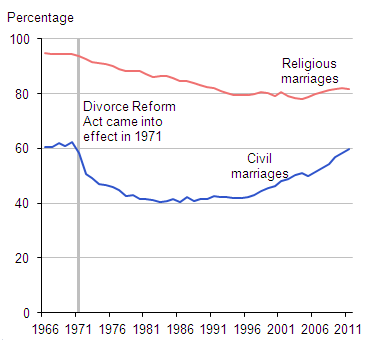
Meanwhile, 61% of civil marriages in 1966 were between partners who had not been married before. That proportion decreased sharply during the 1970s after the Divorce Reform Act came into effect. This Act made it easier for couples to divorce, leading many newly divorced people to remarry and pushing down the proportion of marriages between couples who had not previously been married.
Between 1996 and 2011, the proportion of civil marriages among couples who had not previously been married rose from 42% to 60%. One possible reason for this is that couples who have not been married before are younger on average than those who have been married before.
Younger people are more likely to report having no religion than older people so approved premises provide an alternative to church weddings for the less religious who have not previously been married. Another reason may be that those who have been married before may choose to cohabit with a new partner rather than remarry.
Places of marriage

When looking at marriage in England and Wales one of the best places to start is to examine the marriage timeline to see the extent of change within the continuity of marriage.
Since the 1960s, the proportion of marriages in England and Wales that are religious ceremonies has decreased and the proportion of marriages that are civil ceremonies has increased.
Civil marriages include ceremonies in register offices, as well as marriages in approved premises (such as hotels, stately homes or historic buildings), which have been allowed since the amendment of the Marriage Act in 1995.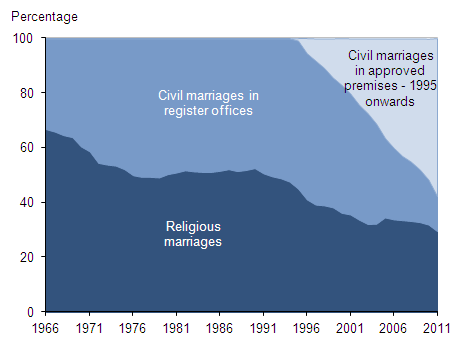
The proportion of religious marriages roughly equalled that of civil marriages during the 1980s, before starting to decrease again in the early 1990s. By 2011, less than 30% of marriages were religious marriages – the lowest percentage on record.
Since 1995, the percentage of marriages taking place in approved premises has increased steadily from 1% in 1995 to 58% of all marriages in 2011. For the seventh consecutive year, there were fewer religious ceremonies than ceremonies in approved premises.
Civil marriages in register offices have also fallen since 1995. In 2011, 13% of marriages took place in register offices, a level not seen since the 1880s. One of the most significant changes to the law regarding marriage is the introduction of same-sex marriages in 2014.
Alternatives to marriage – cohabitation
In 1994, the earliest date for which figures are available, 75% of couples marrying in a civil ceremony lived together before getting married.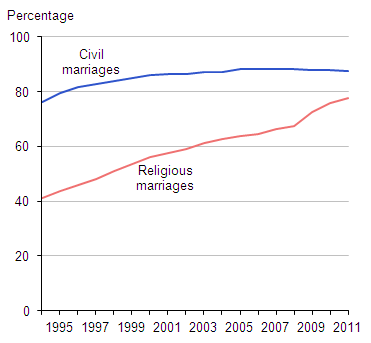 This percentage increased steadily to 88% in 2011.
A lower percentage of couples having a religious marriage cohabited before marrying for all years. However the gap has narrowed over time. In 1994, 41% of couples having a religious ceremony lived together before marriage, almost doubling to 78% in 2011.
Other statistics show that the number of couples cohabiting in the UK has doubled since 1996, illustrating that cohabitation is now more common, both as a precursor and an alternative to marriage.
A
- ACORN (geodemography)
- Abstraction (sociology)
- Accumulation by dispossession
- Achievement in British Education
- Action group
- Age grade
- Aggression
- Alienation
- Altruism
- American Sociological Association
- Annee Sociologique
- Anomie
- Antinaturalism
- Antipositivism
- Appropriation (sociology)
- Articulation (sociology)
- Artificial society
- Assimilation (sociology)
- Astrosociobiology
- Attitude (psychology)
- Ayllu
B
- Bachelor group
- Band society
- Behavioral finance
- Block party
- Blogstream
- Body language
- Bombsite
- Bully
- Bundling (tradition)
C
- Cantometrics
- Charismatic authority
- Cheating
- Chicago school (sociology)
- Class analysis
- Class conflict
- Classlessness
- Clustering (demographics)
- Color psychology
- Communal reinforcement
- Communication theory
- Computational sociology
- Condition of Farm Labour in Eastern Germany (book)
- Conflict theory
- Connectors
- Counterculture
- Criminology
- Crisis of 2020
- Cultural artefact
- Cultural capital
- Cultural ecology
- Culture of fear
- Culture shock
D
- Demography
- Deviancy amplification spiral
- Deviant behavior
- Disability studies
- Discontinuity view
- Division of labour
- Dramaturgy (sociology)
E
- Economic development
- Economic sociology
- Environmental sociology
- Ethnic stereotype
- Ethnic stereotypes in popular culture
- Eurocentrism
- Externalization
F
- Family reunion
- Family values
- Folkways (sociology)
- Formal organization
- Formal social control
- Frankfurt School
- Freak scene
- Functionalism (sociology)
G
- Gender and sexuality studies
- Gender studies
- Generalized other
- Ghetto
- Glocalization
- Granfalloon
- Grounded theory
- Group (sociology)
H
I
- Industrial Sociology
- Informal social control
- Institute for Social Research
- Interaction
- Interactionism
- Internalization
L
- Leipzig school (sociology)
- Lifestyle
- List of lifestyles
- List of publications in sociology
- Local community
- Localism
M
- Macrosociology
- Masculinity vs femininity
- Mass media and public opinion
- Matriarchy
- McDonaldization
- Means of protection
- Medical sociology
- Memetics
- Methodological individualism
- Microsociology
- Misanthropy
- Missionary Kids
- Modernity
- Modernization
- Monoculture
- Monopoly on the legitimate use of physical force
- Moral panic
- Mores
N
O
P
- Patriarchy
- Peer group
- Performance Studies
- Personality
- Philosophy
- Political sociology
- Positivism
- Power (sociology)
- Power elite
- Power-elite model
- Program evaluation
- The Protestant Ethic and the Spirit of Capitalism
- Psychiatric imprisonment
- Public opinion
- Punishment
- Pure sociology
R
- Racial realism
- Racism
- Rational-legal authority
- Reciprocal socialization
- Reform movement
- Resource curse
- Role
- Rural sociology
S
- Science studies
- Self (psychology)
- Self-understanding
- Shibboleth
- Social
- Social Darwinism
- Social actions
- Social change
- Social constructionism
- Social fact
- Social geometry
- Social influence
- Social mobility
- Social movement
- Social network
- Social philosophy
- Social psychology
- Social reformer
Taken from http://www.aboutsociology.com/
If we apply Stephen Lukes’ analysis of power, Julia Gillard’s removal from office is illustrative of the first face of power. Yet maybe the 2nd face of power would be more useful to explain her removal if there’s evidence of people within her political party setting an agenda to remove her as their leader by ‘preventing’ any discussions on how to help her enhance her status.
Notwithstanding these possibilities it might be more appropriate to apply Lukes 3rd face of power in order to understand what’s occurred. Misogyny is ideological in the sense there’s a conscious application of a cohesive idea to create a false consciousness for the recipients of that idea in order to create a biased or distorted view for the benefit of a social group – in this case men.
A good example is evident in the way the media presented Andy Murray’s 2013 Wimbledon win such as the Times ‘Murray ends 77-year wait for British win’. These and similar headlines, had the effect of airbrushing Virginia Wade’s 1977 from history.
For Lukes his radical 3rd face of power identified the insidious features of those groups exercising power is:
‘…..to prevent people, to whatever degree, from having grievances by shaping their perceptions, cognitions and preferences in such a way that they accept their role in the existing order of things, either because they can see or imagine no alternative to it, or because they see it as natural and unchangeable, or because they value it as divinely ordained and beneficial. To assume the absence of grievance equals consensus is simply to rule out the possibility of false or manipulated consensus by definitional fiat.’ ( Lukes, 1974, p24)
Therefore if we apply the above extract to the Virginia Wade extract, women themselves can become ‘misogynist’ by ‘thinking’ Andy Murray was the first British player to win a Grand Slam title at Wimbledon for 77 years.
Returning to feminist social theory helps explain the impact of this
Return to Lukes faces of power
Alternatively you can return to the role of power in the family
For more background information regarding Nietzsche while this BBC documentary Human: All too human explores the life of this influential philosopher.
Return to understanding postmodernism
New research from the Office of National Statistics (2012) suggests the phenomenon of the househusband has seen a rapid explosion in numbers, but experts say the trend is less about choice and nurture than an economic necessity that is not being recognised by (social) policymakers.
This ONS video highlights the 45,000 reduction of women looking after the home (1:46 mins). The data below helps provide a context in the way some commentators interpret the significance of this social trend: Guardian Telegraph Daily Mail
Figures for men:
- In 2002, there were 190,000 men who were classified as ‘economically inactive, looking after the family/home’.(i) In August– October 2012 there were 220,000(ii) – an increase of 30,000 men.
- In 2002 there were only 80,000 men not working because they were looking after children (42% of the total); the rest
were looking after disabled relatives or similar.(i) Assuming that proportion hasn’t changed (the ONS no longer separates them out), the number of men looking after children full-time in 2012 will be 92,632 (a growth of 12,632 men in a decade.) - In 2002 only 39,000 of these 80,000 men were at home looking after children under school age.(i) Assuming the same proportions today, there are 45,158 men looking after children under school age in 2012.That’s 6,158 more men looking after babies and toddlers than there were in 2002.
- For the years in between, the figures show a pretty slow but steady growth, albeit a small one in total.
Figures for women:
- In 2002, there were 2.199 million women who were classified as ‘economically inactive, looking after the family/home’.(i) In August– October 2012 there were 2.11 million(ii) – a drop of 88,000 women.
- In 2002 there were 1.707 million women not working because they were looking after children (78% of the total); the rest were looking after disabled relatives or similar.(i) Assuming that proportion hasn’t changed, the number of women looking after children full time in 2012 would be 1.639 million – an decrease of 68,311 women in a decade.
- In 2002, 1.101 million of these 1.707 million women were at home looking after children under school age. (i) Assuming the same proportions today, there are 1.057 million women looking after children under school age in 2012 (a drop of 44,060 women looking after babies and toddlers since 2002.)
(i) Office for National Statistics(2002) The economically inactive who look after the family or home
(ii) Office for National Statistics (December 2012) Table: INAC01 Economic inactivity: reasons (Source)
 sociologytwynham.com