
For example functionalists see crime as a threat to social order. Someone who commits a crime or a deviant act has gone against the shared norms and values of society. Some people are socialised into crime. However, some functionalists see crime as being normal’ and also, an integral part of all healthy societies.’  While too much crime constitutes a threat to social order, too little crime or deviance is unhealthy. It shows that the norms and values of a society are so strong that they prevent the innovation and change necessary for a healthy society. Crime and deviance can be viewed as functional[CT1] .
Durkheim argued that by having public punishments and executions for criminals, society was reminded of its shared norms and values. Also, Kingsley Davis, (1961) argued that crime and deviance can act as a safety valve. He claimed that there is a conflict between a man’s instinctual need for sexual satisfaction and society’s need to restrict the legitimate expression of sex to within the family. Therefore, prostitution is functional because it provides sexual satisfaction without threatening the family as an institution. YES MARRIED MEN SHOULD USE  PROSTITUTES!!!
However, it is argued that suggesting functions for crime and deviance is not the same as finding an explanation for them. Downes and Rock, (2003) said: “It is one thing to assert that crime can be made to serve some social end or other once it has occurred- for example, to heighten solidarity by uniting against the offender. It is another step altogether to explain crime as promoted in advance by society to bring about that end[CT2] .’
There are subcultural theories which lean towards functionalism. In 1955 Albert Cohen came up with status frustration.’ Many working class youths who cannot gain status legitimately, become frustrated and therefore try to gain status through illegitimate means. They create their own subculture and reject the norms and values of mainstream society. Although they have failed in mainstream society, they can solve their problems by gaining status and respect from their peers within a delinquent subculture. The crime committed within these subcultures is often non-utilitarian, i.e. it is done for no financial gain. For example vandalising a building does not make money for the criminal. However, the criminal will gain status among his peers[CT3] . Cohen’s theory offers a good explanation for non-utilitarian crime (this means there’s no financial gain), and why crime is committed in groups[CT4] . However, there are other explanations for working class delinquency.
The two main broad perspectives that explain crime are Marxism and functionalism. Each covers a range of theories and explanations such as subcultural theory in both Marxism and functionalism, and status frustration in functionalism.
From a Marxist perspective crime and deviance can only be understood in terms of capitalism and class struggle. Capitalism creates inequalities which lead to conflict. Greed, selfishness and want are associated with capitalism, and it is these which lead people to committing crime. In a capitalist society there are pressures to break the law, which affect people from all sections of society from the wealthy to the poor. Crimes are often motivated by financial gain. However, there also crimes which are not motivated by financial gain, which are also called non- utilitarian crimes.’ These crimes can be seen as an expression of the frustration and aggression which the capitalist society produces. For example someone might vandalise public property purely out of frustration.
Marxists claim there is one law for the rich and one for the poor. The law is enforced systemically, and it is biased in favour of those at the top. Corporate crime costs society much more than benefit fraud committed by the lower classes, and yet it is those at the bottom who are targeted more. The working classes are targeted more by the police as they often commit crime which is easily visible and therefore they are easier to prosecute. This could be explained in terms of the self fulfilling prophecy .
Police believe young working class males are more likely to commit crime and therefore they target them more often, for example with stop and searches. This in turn makes them actually commit more crime, and so the prophecy fulfils itself.
The sociologist Phil Cohen uses Marxist subcultural theory to explain crime and deviance amongst young, white working class males. He argued that these young working class males reacted to their changing  economic circumstances. For example, the 1960s Mods reacted to the new idea of affluence. Even though they were working class, they aspired to be middle class. They wanted to show that they had money, so they wore clothes that they believed to be middle class, and drove expensive Lambrettas. They often got into fights with the Rockers, another youth subculture .
Cohen argued that youth develop a cultural style as a means of coping with their particular circumstances and of resisting the dominant values of society. For example, when the 1970s Skinheads were faced with unemployment, they continued to wear traditional working class style clothes to resist against society. They had built up frustration against society and this often led to rebellion and conflict.
Marxist approaches have the advantage of combining explanations of crime which cover people of all social classes and a wide variety of offences. It also clearly explains why there is selective enforcement of the law in capitalist society. However some sociologists disagree with the Marxist perspective. They reject the view that there is a fundamental conflict of interest between the ruling and subject classes in capitalist society, and the exploitation of one by the other .
These guys argue that crime is useful to society!!
Yes, it’s true! They say this because crime has a function in society. It’s all about that social body again. So in the same way the family is a functional prerequisite, so too is crime!
Durkheim’s point is crime and deviance can actually help maintain social order because it unites the rest of  society in the disapproval of deviant behaviour. The majority consensus on acceptable behaviour is built on people all agreeing something is wrong. For example the newspapers would slate someone famous who was involved with group sex. Think Mosley Fomula I boss.
Durkheim (1897) said deviancy allows for social change to occur. Durkheim said all societies need some change to remain stable and healthy. If society acts positively to deviant behaviour it starts the process for that behaviour to be seen as non-deviant in the future.
Durkheim said crime moves from the functional to the dysfunctional when the level of crime is either too high or too low. Too high and it threatens social order. Too low and there’s no social change.
The rate at which individuals deviate from the norm is related to the degree of integration and cohesiveness of that society. Because society encourages individualism and unlimited aspirations, situations arise when such aspirations can’t be achieved. Unless society imposes new regulations on aspirations then a state of anomie/normlessness will occur resulting in a higher tendency to commit suicide.
More in depth detail regarding functionalist to subcultural perspectives here!!!!functionalist
Definition of crime and deviance is:

Deviance = behaviour which goes against all the norms, values and expectations of society. For example coming to school in your speedo’s

Crime = behaviour which breaks laws and you’re punished by the legal system. For example speeding in your car
Downes and Rock (1988)- said: “deviance may be considered as banned or controlled behaviour which is likely to attract punishment or disapproval”
Once a consensus is created about what is good and bad social behaviour the difficult thing is making sure you get everyone to do as they’re told – social order. Social control is the way society regulates the behave of its members of society, this is known as social control.
There are two types of social control, ‘formal’ and ‘informal’ social control. Formal is the police and the law, while informal comes from primary and seconday socialisation through the media, family, schools etc.
 Revision image
Functionalists see the family as being integral to the ‘functioning’ of the social body. This has to be understood in the same way the heart is a functional prerequisite (basic need) of the human body. Using this same principle the family is seen as a functional prerequisite of the social body, without it the social body (society) would fail to function properly.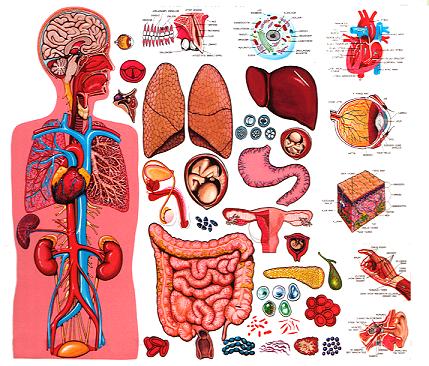
Therefore in the same way the human body needs the brain to make sure all the other major organs work properly, society needs the family to function properly as it socialises children into the culture they live in. Learn more about functionalist social theory.
So what are the functions of the family?
In the 1940s Murdock (a functionalist) examined 250 societies in different cultures. He concluded the family is universal and inevitable as no society had a substitute for the family. He concluded the ‘nuclear family’ is the ideal model and this model achieves four distinct functions:
-
Sexual – the family provides stable sexual relationships for adults and controls the sexual habits of its members
-
Reproduction – helps provide new members of society
-
Socialisation – teaches children the norms and values of society to keep society going
-
Economic – pools resources for all family members to share
Murdock’s point was the sexual function of the family provides sexual gratification for both men and women. Such a function is useful as it stabilizes the family by keeping both parents emotionally attached. For example if either parent wasn’t sexually satisfied then they might be inclined to stray and so threaten family stability.
Kingsley Davis (1937) argued prostitution has a family function as it provides sexual satisfaction without threatening the family. Murdock wasn’t without his critics. Murdock assumes all families function well, such an approach ignores less ‘happy’ families neither does his recognise the role other institutions could play in achieving the four uses listed above. Another functionalist, Talcott Parsons, developed Murdock’s approach.
Test your knowledge of this section test-knowledge-2
Follow this link for a PowerPoint defining socialisation, stereotype, stratification and social-class
If you’re fed-up of read from PowerPoints then watch this short film on stratification by social-class. Although it’s a US film, its points are still relevant to the UK!
Want to understand stereotypes better than my PowerPoint??? Then watch this clip about racial stereotyping!! And yes it was common to see this sort of stuff even when I was a boy!!
FInally socialisation. There’s two types primary socialisation which is taught by your family and secondary socialisation which is learnt behaviour from either your friends, the media or at school. These clips below illustrate this point!
What type of family do you live in?
Watch this clip and say what type of family it is
Next take a picture/video of your family and email to me as well as identifying what type of family it is!
Listed below are the variety of structures families are found in:
Beanpole – in countries like Britain and the US, the number of children per generation has steadily gone down, while life span has increased. This has led to a shape of family tree that some researchers have likened to a beanpole — tall and thin, with few people in each generation.
Classic extended family – an extended family sharing the same household
Cohabitation – a couple living together who aren’t married
Extended family – a family containing relatives in addition to the nuclear family
Gay or lesbian family – same sex couple living together with children
Kin – relatives based on marriage or genes
Lone parent family – lone parent (either gender) with dependent children
Modified extended family – an extended family living apart but still in communication via phone, email, Skype etc.
Monogamy – a married couple of the opposite sex, who have sexual relations with each other
Nuclear family – a family consisting of an adult male and female with one or more children (including adopted)
Polygamy – a marriage involving two or more wives or husbands
Reconstituted family (blended family) – a family formed out of another relationship, otherwise known as a step-family
Symmetrical family – authority and household tasks shared between male and female partners
What are pressure groups?
The best way of answering this question is to watch the following clip. While you’re watching the clip list the different types of pressure groups mention in the piece.
Identify one similarity between each pressure group
First watch the clip below:
Now post your comment whish identifies all the key aspects of what education is for in addition to learning subjects!! (only wtach flim until 1 minute 7 seconds).
Next identify the recent developments which show the function of eduction (from 1 minute 8 seconds)
 sociologytwynham.com