
 Family life has more or less been discussed in these pages as being positive for children.
But are there any negative aspects of family life for children?
The term ‘dark side’ refers to abuse within the family, particularly, but not exclusively, towards women and children. The NSPCC’s website has published a list of abuse data – sexual abuse statistics; physical abuse statistics; neglect abuse statistics.

In essence research conducted by the NSPCC in 2000 found that 10% of children suffered serious abuse or neglect at home caused by their natural parents. While in 2005 the teen magazine Sugar in association with the NSPCC found 15% of teenage girls were hit by their parents.
It is likely that more abuse does go on at home as Childline the confidential helpline for children, as their statistics indicate much more abuse by parents.
Another aspect of the ‘dark-side’ of family life is domestic abuse. The extent of domestic abuse is still evident in 2013 with Essex police saying they receive 80 a day on the issue.
The figures on domestic abuse in the UK are as follows:
- 23% of all assaults recorded by the police are domestic abuse assaults (British Crime Survey 2000)
- Many studies have found that 1 woman in 4, at some stage in her life, experiences domestic abuse (the most recent shows a figure of 45% – British Crime Survey 2004)
- On average, 42% of female murder victims are killed by current or former partners (Criminal Statistics 2001) In the UK, an average of 2 women die per week due to domestic abuse (Home Office)
- Police reports, of those who call for help, breakdown as follows:
- 81% female victims attacked by male perpetrators
- 8% male victims attacked by female perpetrators
- 7% male victims attacked by male perpetrators
- 4% female victims attacked by female perpetrators
Rape in marriage is also a form of domestic abuse, though it is sometimes more difficult to measure as women are often reluctant to categorise such incidents at home as abuse or are unlikely to report it to the police because of fear of recriminations, or embarrassment.
What is alarming about abuse is how the Sugar report mentioned earlier found that 16% of teenage girls had been hit by their boyfriend! Worst of all 43% of girls who responded to the survey thought it was alright for a boyfriend to get aggressive and 6% thought it acceptable for a boy to hit a girl!!!
Domestic abuse can also in the form of Economic abuse is when the abuser has complete control over the victim’s money and other economic resources. Usually, this involves putting the victim on a strict “allowance,” withholding money at will and forcing the victim to beg for the money until the abuser gives them some money. The follow video sums most of the above up.
What are the reasons for domestic abuse?
There are many different theories as to the causes of domestic violence. These include psychological theories that consider personality traits and mental characteristics of the offender, as well as social theories which consider external factors in the offender’s environment, such as family structure, stress, social learning. As with many phenomena regarding human experience, no single approach appears to cover all cases.
Nevertheless Radical feminists explain domestic violence as a result of living in a patriarchal society. In such societies men control women and violence is simply another control mechanism at the disposal of men in order to keep them in a state of submission. Marxist feminists would point to the structural in equalities caused by capitalism which keeps certain sections of society suppressed consequently women, as they’re already stratified by capitalism, domestic violence is a manifestation of this oppression and so it tends to be experienced by more vulnerable women in society, such as working class-women.
The following Dark Side of Family powerpoint provides an overview of most key points.
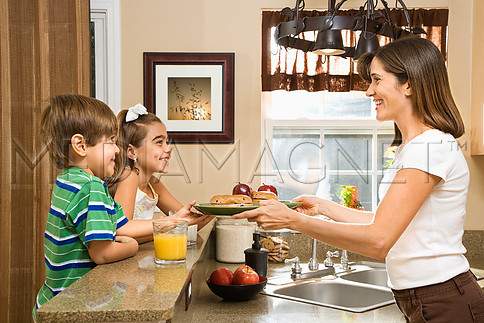 The amount of time parents spend with their children has more than doubled since the 1950s and parents are more likely to take an interest in their children’s activities as well as discussing decisions with them and treating them more as equals, this is known as being child-centred.
Sociologists now say there’s been an increase in child-centredness in the UK. What do you think are the reasons for the increase in child-centred relations in families?
The reasons for an increase in child-centredness are as follows:
- Families have got smaller since the 19th century so parents can spend more time with their children
- Compared with the 19th century parents (especially dads) work less hours
- Increasing affluence has allowed parents to spend more money on their children
- The state has increased its role in guiding parents in the skills of parenting which tend to be more formal through the power of Social Workers, Children Acts of 1998 and 2004 with both established legal rights for children
- Children’s lives have become more complex and roads more dangerous which has meant parents (mainly mum) have to drive them around more to after school activities
- High house prices and the need for Higher Education degrees to get a good job has meant children live longer at home more which has extended these relationships
But are things as simple as this? Maybe life isn’t so child-centred but is instead used as a way of advertisers commercialising childhood by:
- Advertising aimed at young children with sweets, toys etc
- Advertisers using the internet to create ‘advergames’ to promote their products. An example is M & Ms red vs green game
- Advertising aimed at sexualising childhood which is discussed here
- Both parents working and the creation of latch-key children/families
- The growth of bedroom culture with computer, mobile phones TVs and DVD players creating children’s lives which are separate to their parents
Plus there’s the dark-side of family life which is often neglected by those groups promoting child-centredness!
 Following on from the previous lesson, have children’s rights manifest themselves in the world of work?
Are children treated equally at work with adults? In Victorian Britain children certainly didn’t have a childhood in the way we now understand it
Follow this link and construct a comprehensive outline of children’s rights at work in the uk.
What does this tell you about the social construction of childhood in relation to rights and responsibilities?
Moreover is there any evidence on this previous page of study that that maybe children’s rights in the UK aren’t that different to the past and the way children are treated in other countries to day? Follow this link to a small article about growing up in Sweden which pioneered children’s rights!
Next lesson
So how is childhood represented in our culture?
 First of all we need to agree what we mean by the words culture and representation.
In order to understand what representation is draw a tree on the wipeboards and let’s analyse what we see.
Now that we’ve addressed representation let’s look at culture. What is our culture? Make a list of the components parts of our culture.
Now let’s go back to the main question at the start of this lesson. How is childhood represented in our culture?
Two books were written before the 1960s which epitomised two clearly differing representations of childhood. William Golding’s Lord of the Flies saw children as untamed barbarians who needed adults to socialise them into civilised behaviour.
In contrast Enid’s Blyton’s Famous Five idealised children and childhood as being a time of wonderment and innocent adventure, tinged with the odd inconvenient moment.
Famous Five film clip:
Lord of the Flies film clip
So in what way do you think childhood represented in contemporary media? Does this next clip give you any clues to answering this question?
Do any of the following words portray children/childhood as either sinful, violent, carefree or happy. In the same way let’s analyse the social construction of adulthood, how are adults represented?
- What does this tell you about the social construction of childhood?
- Is there a relationship between social policy and the social construction of childhood?
- And finally what role might ideology play in the social construction of childhood?
Wendy Rodgers 2001, argues that both images of children as being caught between innocent and wicked. These representations create images which have been socially constructed in order to help design social policies on the basis that adults should take responsibility for their child’s upbringing so they will learn to conform to society’s norms and values. Everyone is in broad agreement with this view; therefore ideologically this allows governments to create laws which control children for example education policy means children must go to school.
Nick Lee supports Wendy Rodgers by claiming 20th century childhood was socially constructed in order to create to very distinct types of person. As we found adults are socially constructed as being responsible and stable people when compared to the irresponsible and unstable mannerisms of children.
However Lee argues this construction of adulthood has now been eroded.
- Why might Lee argue this, are adults no longer stable, reliable and responsible people?
Lee believes adults are no longer stable, reliable and responsible people because the world is no longer a stable place. Jobs and relationships are highly unstable as jobs and relationships for life have vanished to the extent we now live in what Giddens’ terms as an age of uncertainty where the old certainties of life have vanished to we all now have to adapt ourselves to the changing circumstance of life.
From this children are now treated differently by adults, to the extent children are socially constructed as being very similar to adults to the point they now have their own rights. This evident in the Children Act of 1989 (UK) and the UN Convention on the Rights of the Child (1989). Effectively both these acts put the feelings and needs of children first which changed divorce proceedings as the court now asks the child what they want rather than telling them which used to happen.
Next lesson children & work an independent study assignment about children and work
Is childhood is a natural phenomenon or a socially constructed phenomenon?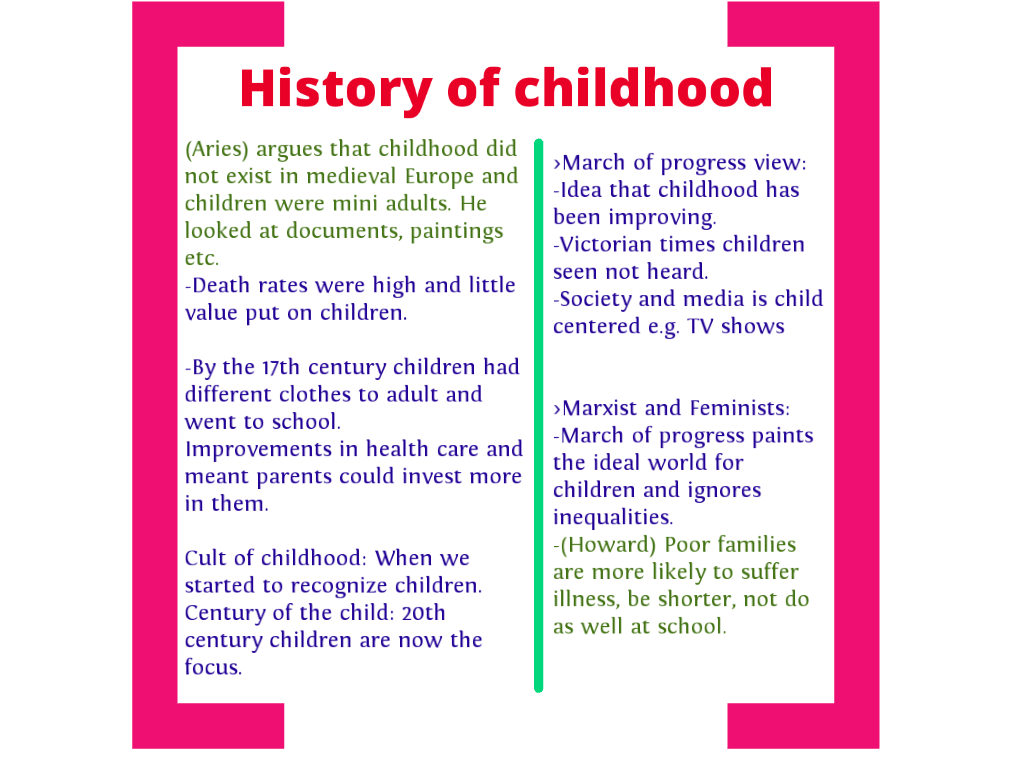
The Powerpoint social construction of Childhood helps with your revision notes while this BBC clip examines ‘childhood’ in Victorian Britain.
Childhood as an age status is not fixed or universal. The experience and meaning of childhood differs across societies, time periods and between different groups. This means having a childhood is not a natural or inevitable period in a person’s life but a socially constructed episode.
This is because historical and cross-cultural studies have shown being a child means different things in different societies. For example you only have to think of the many street children in India to realise in some societies the idea of a childhood does not even exist.
Even in those countries where childhood does exist the period of a pe

rson’s childhood is age dependent. For example in the UK laws define what a child can or cannot do, for example when a child is compelled to attend to school or is allowed to work. In contrast Michelle Johnson has written about the Fulani of West Africa describing how by the age of four, girls are expected to be able to care for their younger siblings, fetch water and firewood and by the age of six will be pounding grain, producing milk and butter and selling these alongside their mothers in the market.
The changing patterns of childhood can be broken into four key periods.
- childhood experience in pre-industrial society – Philippe Aries (1960) Centuries of Childhood argued in the 17th Century childhood did not exist as children were viewed as ‘tiny adults’ – no real difference between children and adults, from a young age and were viewed as economic assets
- early industrial period and childhood – working-class children worked alongside adults particularly in the factories, mines and mills
- later industrial period and childhood – mid 19th century Factory/Mine acts meant children were no longer able to work, children no longer economic assets and 1870 Education Act – children need to be supported
- 20th Century onward – children are now viewed differently to adults in need of support and protection, children are put first helping create the period known as childhood: toys, clothes, TV programmes, food etc
- social policy cementing the development of childhood through the:
- age of consent
- Factory Acts – Contemporary employment legislation
- 1870 Education Act
- 1980 Child care Act
- 1991 Child Support Act
Neil Postman (1982) states that childhood is disappearing as the 19th century divisions between adults and children are disappearing. Children are able to experience things that previously were only available to adults. Postman argues it is the “Frankenstein Syndrome” effect of the mass media is largely responsible for this particularly TV, Internet and social media.
However Diana Gittins (1997) argues studies which treat children as one homogenised group fails to recognise the diversity of inequality between childhood experiences such as social class, gender, ethnicity and culture. Hendrick (1997) identified the discourses of childhood as being socially constructed around the Victorian image of the natural and romantic child which possessing a natural innocence. Two later discourses of childhood proposed by Hendrick (1997) were the child as a family member and the child as a state responsibility (child of the welfare state) in need of protection and care.
You can read more on the social construction of childhood in these two articles Historical constructions of childhood innocence and Are children naturally innocent?
You might like to watch the clips below to consolidate your understanding about the social construction of childhood.
 Are the conclusions we made in the previous lesson different for same sex households?
It has become evident that relations of power in heterosexual families swing in favour of men. In same sex households the emphasis is on equality in their relationships.
Dunne researched the lives of 37 cohabiting lesbian couples in 1997 to find how far this ideal became a reality. Where the couple had children, the childcare was shared equally as was the housework. Yet when one partner worked full-time, that working partner did significantly less housework.
Dunne provides reasons for this greater equality:
- Equalities in the workplace are mirrored at home. So as men tend to have higher status jobs and salaries, this extends into family life and reflects the relationship at home
- Gay and lesbian couples are free from the ‘normal’ social constraints which control our lives. Therefore as they’re constructing new ways of living in public life, they do the same in their private life and so they have more equal relations at home.
Next lesson
Are families patriarchal or matriarchal?
To help answer such a question sociologist Stephen Lukes identified three different views or ‘faces’ on power:
-
decision making (what Lukes termed the first face of power)
-
agenda setting otherwise known as non-decision making (what Lukes termed the second face of power)
-
controlling wishes and desires (Lukes’ own radical or third face of power)
1. Decision making – this examines how power is gained through winning the argument/discussion over an issue. The person or group who win the argument gain all the power and can act on their decision.
- Edgell 1980 discovered was that only about half of the family decisions were taken jointly. The husband dominated the more important decisions like moving house, family finances, and buying a car.
- The more frequent and less ‘important’ decisions were left to the wife. These decisions tended to be about interior decorating, food management, and children’s clothes.
 2. Agenda-setting (or non-decision making) – setting the agenda or non-decision making, some ideas about family life have already been made for people.
Setting of the agenda is important in family life as those people who gain from setting the agenda hold more power.
One example is where men’s jobs are largely seen as being more important that women’s. This transfers to the family whereby a husband’s power comes from his ‘superior job’ and can stop the discussion (agenda is set) of him cooking the evening meal because he’s worked all-day. Therefore because the wife/partner’s is seen to have a ‘lesser’ valued domestic role the agenda is set she’ll cook the meal.
Oakely argues that having set the agenda the wife is becomes dependent on the male breadwinner and women’s housework is seen as different a softer option form ‘real’ work. Defining housework as a female activity means the agenda is set, as such work is naturally female rather than this:
3. Shaping desires – the final type of power is the ability to shape the wishes and
desires of people. This is known as Lukes’ third face of power. This form of power is more subtle than the previous two because it is about one group or individual shaping the wishes and desires of another group/individual without them realising they’re being manipulated as evident in the clip below.
The idea with this view of power is the ability of one group to control another without them knowing it’s happening. This occurs in the family because women have grown to accept their subordinate status through Lukes’ third face of power. One ‘tool’ used to sell a woman’s subordinate status is through ideology.
By cementing certain ideas into society as normal and inevitable women accept their subordinate role as carers and housewives because they’ve been ‘sold’ this idea. In general women don’t try and challenge these normal ‘biological’ ideas because if they do they’re seen as odd.
The next page will allow us to apply each of the three faces of power to real family situations.
The sociology of power highlights the hidden and complex dynamics of family life by  giving us the tools to see how power affects family life. If Stephen Lukes is correct and feminist theorist agree with his view of power, Sociologists, for example, asks how power shapes Parsons privatised nuclear family or Young and Willmott symmetrical family?
Do we live in a period of joint (integrated) or segregated conjugal roles?
To answer these questions we first need to examine what power is and Stephen Lukes helps us do this.
- At this point is worth remembering segregated conjugal roles show a clear division and division between male and female roles. While joint (integrated) conjugal roles show few divisions between male and female partners’ roles.
Is it actually possible to have joint conjugal roles if patriarchal power is all pervasive? With these questions in mind, to what extent is housework an anachronism or true representation of contemporary family life?
Young and Willmott declared in 1973 that the symmetrical family was here! The symmetrical family identified married couples were having joint conjugal roles. This meant in the home the couple share their work and their time around the home. The question is does Lukes view of power challenge Young and Willmott’s model of the family?
The feminist Anne Oakley thought so. Her own research findings challenged Young and Willmott’s concept of the symmetrical family. This was because Young and Willmott’s evidence for their symmetrical family came from their research which found 72% of men helped around the house (1974).
However Oakley’s challenge to Young and Willmott was their figure of 72% came from male respondents only having to answer one dedicated question on housework in their research questionnaire. This meant the figure of 72% was achieved even if the male respondents only did one housework task a week!
Oakley’s own research (1974) found both middle and working class families had greater equality in the designation of domestic duties, but in both classes few men actually did any housework which remains an issue for many commentators today especially as it varies across different countries.
Current research has shown women:
- still become mothers and housewives
- experience a period of full-time work until they have children
- return to part-time work once their youngest child is at school
- housework and childcare remains a woman’s responsibility – known as the dual burden
Indeed even though an increasing number of women work at some point in their lives with men ‘helping’ to do more domestic chores, Allan & Crow 2001 found men’s contribution around the house is limited with women having to work full-time and then do the housework! Supporting evidence comes from the Office of National Statistics time-spent-on-main-activities-by-full.
In addition more recent figures from the National Office for Statistics reveal that at the end of 2012 there were just over 6,000 more full-time, stay-at-home dads (househusbands) looking after babies and toddlers than there were 10 years ago. Yet in the same period, around 44,000 women have stopped being stay-at-home mothers as the ONS summary video explains (@1:28 mins).
What is the relationship between power in the family and housework? The following questions will aid your understanding on the complexity of this issue.
Why is housework and childcare still seen as a gender based issue? The issue for sociologists is explaining why these differences occur. Does Lukes or Foucault view of power best explain why and how these role differences remain?
The answer is complex, especially when people consciously record what spend their time doing each day. The UK 2000 Time Use Survey got respondents to keep a detailed diary of how they spent their time on one day during the week and on one day at the weekend. The survey found that there were substantial differences between men and women and different age groups in the amount of time spent on various activities which can lead to the triple-shift particularly as women are socialised into accepting it as natural and inevitable.
Overall the UK 2000 survey found:
- men spent more time in paid employment than women – an average of 3 hours 48 minutes a day for all men, compared with just over 2 hours a day for all women
- conversely men spent less time than women doing household tasks (cooking and washing up, housework, and washing and ironing) – an average of 2 hours a day compared with 3 hours and 35 minutes for women.
- the differences between men and women were smaller for those in full-time work, with men spending nearly an hour a day more than women in paid work (including study), and women spending nearly an hour a day more than men on household tasks.
- men working full time had an average 23 minutes a day more ‘leisure time’ than women in full-time work.
Follow this link to a PowerPoint on housework-plus
- How would New Right and feminist academics view the above findings/conclusions?
Essay – assess-the-view-that-conjugal-roles-have-become-equal
The 2011 census indicates UK’s ethnic diversity is home grown rather than an outcome of immigration. Manchester University’s Centre on Dynamics of Ethnicity (CoDE) say the growth in Britain’s established ethnic groups has been caused, in the main, by an excess of births over deaths. The extent of the evolving family structures, roles and relationships in the light of ethnic and social change is explored.
Pakistani and Bangladeshi groups have grown each by about 50% during 2001-2011, mostly because more people have been born than have died. For the Caribbean group – who in the came to the UK more than 60 years ago – growth has been less than 5%, which was entirely down to the excess of births over deaths, rather than immigration.
The Irish group, with a relatively elderly population, reduced by 18% over the decade, both from an excess of deaths over births and from net emigration. Some immigrants continue to arrive in their twenties. Of the established groups, only the Indians, they say, have grown substantially through immigration, accounting for two thirds of their growth, though many of these are students.
However, immigration was the main factor for newer Eastern European, African and Chinese ethnic groups, who grew between 70% and 100% in total through the decade.
According to the 2001 and 2011 Censuses, the population of England and Wales grew from 52.4 million in 2001 to 56 million in 2011.
Lead researcher Professor Ludi Simpson said: “By examining the changing age structure of each ethnic group between the 2001 and 2011 Censuses, we have estimated the significance of international migration, births and deaths to population growth, and tracked changing fertility patterns. “And this research shows categorically that, contrary to popular opinion, our diversity is home grown.”
This interactive graphic link below shows the population of England and Wales, organised by ethnic group, as recorded by the 2011 Census. The size of an area is proportional to the number of people who are in each ethnic group. You can click on a region to explore the data in more detail…
From the Census data Manchester University’s research team found:
-
Fertility of most ethnic groups, including White British, has increased a little in the 2000s, but overall there i
 s less difference in family size between ethnic groups than in past decades
 -
Bangladeshi and Pakistani family size has reduced to an average of about three children per family, still higher than other groups
-
Chinese fertility is particularly low, partly because one third of the Chinese population are students
-
People from mixed race backgrounds are the youngest ethnic group in England and Wales. For each of the four mixed groups identified by the Census, between 39% and 47% are under 15, double the figure of 18% for England and Wales as a whole
-
The growth in mixed race groups was mainly due to children born in the decade, though a smaller but significant growth of about 25% was through immigration.

Ethnically diverse family structures:
-
Asian – most Asian households are built on the nuclear model though they do tend to encourage extended family forms. Cohabitation is rare, and marrying young is normal though sometimes arranged
-
African-Caribbean – single parenthood is very high in this ethnic group. In 2001 48% of African-Caribbean families were headed by lone parents (women), they also have the lowest marriage rate and relative divorce rate.
-
Multi-cultural families – there has been an increasing number of partnerships between people from different ethnic groups. Beck-Gernsheim 2002 studies have found there can be conflict between the ethnic groups of origin yet she also found that multicultural marriages help break down social barriers
The clip below provides a visual representation of family diversity on ethnic lines:
Society’s attitude to same sex relations has changed considerably over the years. Before we look at same sex families, it will be useful to watch a 1950s film clip about homosexuality in order to create a historical context for cultural resistance. It is useful to see how cultural resistance helps support the cereal packet family as an idealised family structure.
There has been a relatively small but gradually increasing number of children brought up in same sex families (gay and lesbian families). However the number of children brought up in same sex families is very small. The Office of National Statistics noted that less than 1% of dependent children lived in civil partnership or same sex cohabiting couple families in 2012. (ONS, 2012, page 7)
In 2009 Stonewall commissioned the Centre for Family Research at the University of Cambridge to conduct interviews and focus groups with children of lesbian, gay and bisexual parents. Stonewall‘s findings emphasised the diversity of family life with same-sex families being one family structure which exists among many others.
Macionis and Plummer show how new reproductive technologies have helped to extend the variety of family relationships. It’s worth noting reproductive technologies are used by heterosexual couples as well as single and older women.
These types of families must be seen as families of choice to the extent they actively choose their family members as they have no other means of ‘natural’ chance driven reproduction. These processes are seen to make same-sex relations more democratic as they’re are relationships built on equality.
Many theorists have placed lesbian and gay relationships at the forefront of this cultural shift towards democratisation. Stacey (1996) argues that gay and lesbian families represent an ideal model of postmodern kinship because their conscious efforts to devise intimate relationships are freed from the constraints and the benefits of traditional patterns of family life. Without cultural guidelines and institutional supports same-sex couples are compelled to creatively fashion new forms of association.
- What would the New Right and feminists think of same sex families?
- How do same sex families fit with functionalist and Marxist perspectives of the family?
 sociologytwynham.com