
- it’s difficult to identify and isolate a single cause of a social issue such as underperforming at school as there could inevitably be multiple causes
- because of the above it’s impossible to isolate variables for testing on their own to see if they’re the cause. For example the causes of underachievement at school could be subcultural or economic or dietary etc.
- as sociologists want to study people in their normal environment such as a school, but any laboratory setting is an artificial situation – it’s not real life – a point exacerbated by the fact people would know they’re being experimented on and so The Hawthorne Effect would undermine the validity of any experiment being conducted
- as mentioned on previous page in a laboratory scientists have a control and experimental group so they can compare results. This poses a range of ethical problems for sociologists particularly as the experimental group could suffer negative effects from the experiment being conducted on them. In addition people might not want to be experimented on in the first place
Despite the above some experimental techniques have been used in the form of field experiments.
Water pollution includes marine pollution threatening 58% of the world’s ocean reefs as well as 34% of its fish. Half a billion people lack access to clean drinking water and 25 million people die annually from drinking contaminated  water. Criminals perpetrating such crimes include businesses and governments.
Interpol’s crime unit has identified nine different types of water pollution ranging from water spill-off to the use of cyanide for fishing. Their handbook takes a globalised approach to solving such issues. The handbook can be downloaded here: volume I; volume II.
The World Wildlife Fund (WWF) 2014 report found wildlife in the tropics has declined by 60 per cent since 1970. Iconic species like tigers, turtles, gorillas and hundreds of birds such as the white-rumped vulture are in danger of going extinct, as well as thousands of lesser-known animals.
Freshwater species in the tropics are down a disastrous 70 per cent, with animals like the Amazon river pink dolphin already dying out. The ‘Living Planet Index’ found that the numbers of 2,500 species in 8,000 populations around the world has fallen by 30 per cent.
The WWF report blames the rate of human consumption, that has doubled in under fifty years, meaning rainforests are being cut down, the seas overfished and grassland ploughed up for farming.
The phrase “organized crime” typically conjures up images of drug trafficking or stolen-car rings. But it turns out that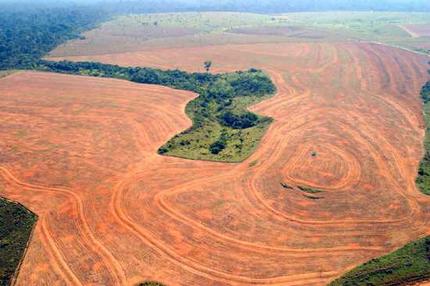 ecological crime is a new branch of global organized crime. The illegal logging trade in tropical rainforests is just as lucrative — and far more destructive. As a result of illegal logging, only 10% of the original primary forest cover remains todays precious resources like tropical rainforest.
Between 50 to 90 percent of forestry in tropical areas is now controlled by criminal groups, according to a new report (pdf) from the United Nations and Interpol as a result of deforestation – illegal logging – only 10% of the original primary forest cover remains today.
Because of this some commentators argue it is of vital importance that national and international laws are established to address this global crime. However, this remains a tremendous challenge for many countries to address the causes of illegal logging, the extent of deforestation and the solutions, both at a (trans)national level as well as on the level of local communities.
Burning fossil fuels from cars, general transport and industry is adding 3bn tons of carbon into the atmosphere every year. These emissions are increasing at a rate of 2% per annum and are seen to be contributing to global warming. From South’s perspective the criminals are governments, businesses and consumers.
In his 2009 report, Crime is in the Air Professor Reece Walters highlighted the human costs of air pollution and failed attempts by successive governments to adequately regulate and control such harm. An estimated 24,000 British residents die prematurely every year and thousands more are hospitalised, because of air pollution.
Furthermore, the European Union is currently preparing a legal case against the British government for repeatedly breaching pollution levels. Professor Walters points out that more than 20 towns and cities have been found to be emitting pollution at twice the level specified in WHO standards – See more at here:
Scientists researching the natural sciences (physics, chemistry, biology) conduct their research in laboratories. In  laboratories scientists are able to control the variables (e.g. temperature, light etc.) so an experiment can be undertaken in order to test out a hypothesis (a prediction which can be tested). The strength and weaknesses of the experimental method in sociology are:
The advantage of laboratory experiments are:
- makes isolating and manipulating variables easier so causes of events can be identified
- other scientists can easily repeat the same experiment
- they’re high in reliability as other researchers can replicate the same experiment and achieve the same results
- comparisons can be made with similar experimental research
- scientists can test their hypothesis in controlled conditions
By being in control of all the variables the scientist can adjust or isolate any variable in order to find out what might influence the hypothesis under scrutiny.
Let’s imagine that a scientist is conducting an experiment to test if light will result in more growth in salmonella in raw chicken than temperature.
In the laboratory the scientist could for example increase the amount of light (the independent variable is the variable that is manipulated by the researcher during an experiment) – in the laboratory to measure the effect of bright light on a piece of raw chicken in causing bacteria (the dependent variable is the bacteria growth) to flourish.
If nothing changes in the chicken the scientist might change the independent variable from light to room temperature while still keeping the dependent variable (the bacteria) the same.
Therefore in the next laboratory experiment the scientist increases the room temperature by 10 degrees and then measures the amount of salmonella now on the raw chicken. If there is a critical increase in the amount of salmonella bacteria the scientist can assume the temperature change (the independent variable) caused the number of bacteria (the dependent variable) to increase.
However in order to make certain it is the temperature and not the meat itself which could be the cause of the salmonella increase scientists, have a control group and an experimental group.
The researcher will take use two pieces of identical chicken one being named the control piece of chicken and the other the experimental piece of chicken. The scientist could increase the amount of light on the experimental group to see if the variable being investigated (the independent variable) changes compared to the control group. If light is seen to have no effect on the experimental group then that variable can be dismissed as a cause and the other variable such as temperature could be tested.
Using the objective procedures of the experimental method the researcher can eventually discover what causes salmonella bacteria to flourish as both groups were identical before the experiment and any subsequent changes could only have occurred by the changes imposed during the laboratory experiment.
The weaknesses with the experimental method in sociology are

Interpretivism (qualitative methods)
The core principles of interpretivism are:
- interpretivists are anti-positivist in principle as they are sceptical about sociology’s scientific status
- they reject the view human behaviour is predictable in the same way the natural world is seen to be
- unlike molecules human beings are conscious entities and act with purpose
- intrepretivists argue human behaviour is not the result of external forces (social facts) instead sociologists need to understand the meaning and motivations behind individual action (verstehen)
- interpretivists use qualitative methods
Intrepretivists prefer small scale research methods which get to understand (verstehen) the feelings and experiences of individuals as opposed to the large scale research undertaken by positivists.
Weber’s position is sociology is a science which attempts to interpret how people behave (social action) in order to understand an individual’s motivations for their actions.
For interpretivists it is the sociologist’s interpretation of these actions which is key to gaining verstehen (understanding) which is the opposite to the positivists desire to discover social forces (social facts) acting on individuals and so affecting their behaviour.
Their methods include:
Method Why it’s a preferred method
unstructured interviews the flexibility of the method & ability to build a rapport
participant observation enables researcher to observe behaviour in natural setting & gain empathy
non-participant observation enables researcher to observe behaviour in natural setting & gain empathy
(observations can be overt or covert)
Follow this link for more detailed information on interpretivist methods.
There are two types of quantitative and qualitative sources of data – primary and secondary.
Primary data is that collected by sociologists themselves through social surveys such as structured interviews. This page examines the types of primary qualitative research.
Secondary data is data which already exists such as that found in newspapers, novels, literature, letters, diaries, police records, school results, government reports etc. This page examines the different types of secondary research data as an overview while this page looks at secondary research data in more detail.
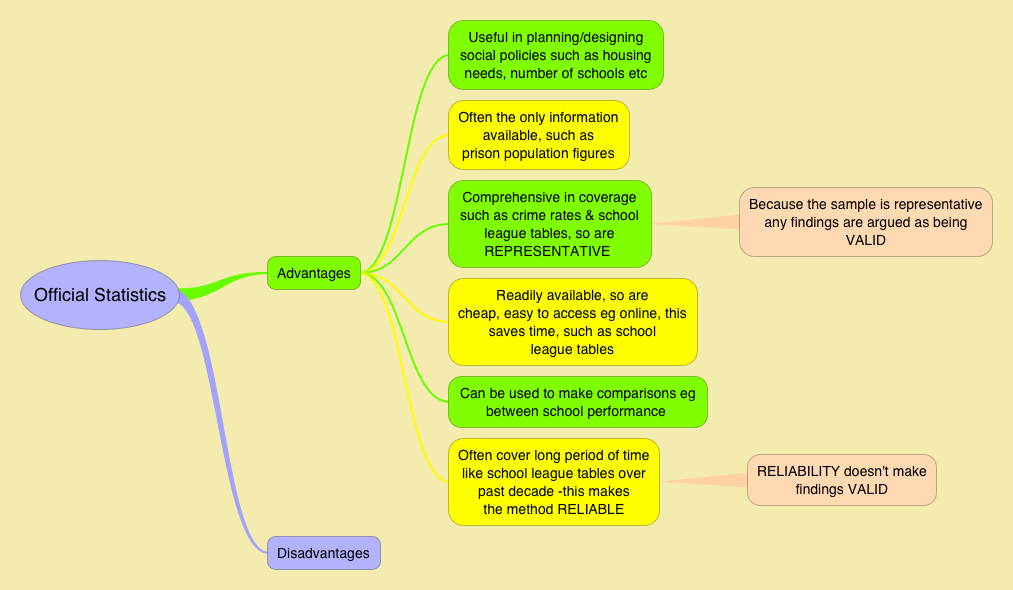
Representativeness refers to the chosen sample being a representative sample.
A representative sample is a smaller group (the sample via sociologists chosen sample method) taken from the survey population which contains a good cross-section of the survey population.
The constitution of a good cross-section means it has the correct proportion of people with different ethnic origins, ages, social classes and gender.
Data gathered from a good cross-section is seen to provide (roughly) the same results as if the whole population had actually been surveyed/questioned.
 sociologytwynham.com