
Such is the range of schools children can attend it can be very confusing to understand what the difference hence this page which takes you to a dedicated definition page for each one in no particular order.
Converter academies
Maintained schools
Community schools
Foundation and trust schools
Voluntary aided schools
Voluntary controlled schools
Grammar schools
Independent schools
The admissions policies and other differences are available here.
The source for this material came from http://www.newschoolsnetwork.org
The comparative method is where the researcher collects data about different social groups (eg working-class; middle-class and upper-class) and then compares one group with another to identify what is evident in one group but not another.
Therefore using the example of social-class a researcher might want to compare the amount of short-term loans – such as Wonga loans, one social-class has compared with another.
The principles behind such a method come from positivists who try to isolate the and identify the cause of social events and behaviour. Durkheim’s study on suicide was an example of the comparative method. By comparing official statistics between various societies he argued he was able to identify what was evident in one society and not in another which might cause suicide.
The Issues
- a) Gender gap
As stated above, Black Caribbean students have the lowest attainment levels out of all ethnic groups except Gypsies, Roma and Travellers. This becomes even more pronounced when looking at Black Caribbean boys. Whilst there are  attainment gaps between boys and girls amongst all ethnic groups, the gender gap is even greater between Black Caribbean girls and boys, being 12.5% compared to the national gender gap of 7.3%
http://www.education.gov.uk/rsgateway/DB/SFR/s001057/sfr03-2012.pdf.
b) Behaviour and exclusions
- Black Caribbean boys in particular are twice as likely to be characterised as having behavioural, emotional or social difficulty compared to White British boys (Stephen J. Ball, 2008.
- In addition, Black Caribbean boys are far more likely to be excluded from school – the Office of the Children’s Commissioner found that they are 37 times more likely to be excluded than girls of Indian origin.
- Also, in 2009-10, if you were a Black African-Caribbean boy with special needs and eligible for free school meals you were 168 times more likely to be permanently excluded from a statefunded school than a White girl without special needs from a middle class family.
- Being excluded from school has a massive impact on a pupil’s attainment levels.
For example, research by David Gillborn and David Drew found that excluded pupils are 4 times more likely to finish their education without having gained academic qualifications. Subsequent access to higher education and employment is therefore limited. Furthermore, if a child has lower academic achievement they are more likely to become involved in criminal activity (2010).
Racism and unconscious bias
A reason for educational attainment differences could be unconscious bias from teachers, leading them to assume that children of certain ethnic groups are more (or less) likely to misbehave or work hard. There has been concern from a sizeable number of newly trained teachers that their training does not well prepare them for teaching pupils of different ethnicities. Improved teacher training on this issue may improve outcomes.
Setting
- There has been a range of evidence suggesting that school decision making and selection processes about access to course and qualification routes in schools work against the interest of Black students. For example, evidence suggests that Black pupils are more likely to be entered for lower tier exams, meaning that these students are only able to able to achieve a maximum grade of a C or D, and other evidence has found that Black Caribbean and African students are less likely to be indentified for gifted and talented programmes (Stephen J. Ball, 2008).
- Evidence also suggests that Chinese and Indian students are more likely to be entered into higher sets. Setting can be problematic given that a pupil’s set is decided at a young age, and evidence suggests that teacher assumptions that Black students will achieve poorly and Chinese/Indian students highly may result in children being put in an inappropriate set, and thus effectively pre-determine how high a grade it is possible for them to achieve.
Exclusions and discipline
- Research by the former Department for Education and Skills (Getting it, Getting it Right 2006) suggest a number of reasons as to why Black pupils are disproportionately excluded, including institutional racism. The report argues that Black pupils encounter both conscious and unconscious prejudice from teachers– for example, research has found that throughout their education black pupils are disciplined more (both in terms of frequency and severity) and often for milder offences than those leading to their White peers being punished.
- The report recommended that to help decrease exclusions of Black pupils there should be consistent and continued monitoring of pupil progress to identify problems early on, more teacher training on matters of race equality, involving pupils in designing and setting rules, and providing support from academic mentors.
Post-school achievement
It is important to take into account, that whilst attainment gaps are decreasing among minority ethnic groups, they still experience unequal outcomes at university and in the workplace post school. The picture is extremely striking for Indian students who, overall, do far better than White students at school yet are more likely to attend less prestigious universities, and are more likely to be unemployed.
Types of university attended
- The proportion of university places taken by BME students has increased from 13% of students in 1994/95 to 23% in 2008/09, a figure broadly proportionate to their size in the young population (EHRC Triennial Review, 2010)
- However, at least 44% of all Black, Pakistani, Bangladeshi and Indian graduates attended post-1992 universities, or former polytechnics compared to 34% of other ethnic groups. This is despite the fact that Indian students are second highest achieving ethnic group (National Equality Panel, 2009)
- All minority ethnic groups, with the exception of students from Chinese backgrounds, are more likely to be at ‘new’ institutions (Runnymede, 2007). There are more students of Black Caribbean origin at London Metropolitan University than at all the Russell Group universities put together (Runnymede, 2007)
- In 2009 only one Black Caribbean individual was accepted to study on a course at Oxford University (University of Oxford, 2010)
Attainment at university
- 66.4% of White students studying first degrees received a first class or second class honours qualification, compared to 48.1% of BME students overall and only 37.7% of Black students (Equality Challenge Unit, 2009)
- A higher proportion of lower second class degrees were awarded to Black, Pakistani and Bangladeshi graduates than upper seconds (National Equality Panel, 2010)
- Black British students, Asian British Pakistani students and ‘other’ British Asian students are significantly more likely to drop out of higher education. (N. Powdthavee and A. Vignoles, 2007)
After university
- Chinese boys are among the highest performing groups in our schools. After university, however, they can expect to earn 25% less than White graduate (EHRC).
- Despite being the second highest achieving ethnic group, Indian young people looking for work are more likely to be unemployed compared to White British young people (24.2% compared to 20%, ONS 2012).
- 44.4% of young Black people and 33.3% of young Pakistani/Bangladeshi people looking for work are unemployed (ONS 2012)
RECOMMENDATIONS
- Re-introduce the ring-fenced Ethnic Minority Achievement Grant
- Ensure the new curriculum is inclusive and promotes diversity. We would also recommend retaining Citizenship as a subject at all levels, not just in secondary schools
- Teacher training needs to be improved to equip all teachers to be able to teach a diverse range of students. This training should also explore issues around unconscious bias.
- There has been little research into effective independent careers advice and guidance that young people from BME communities need in order to access a wider range of universities or the labour market on graduation. Work to explore whether careers advice is resulting in some ethnic groups (such as Indian students) choosing less prestigious universities or low paid/over-competitive careers, is needed.
- Reintroduce targets to recruit ethnic minority teachers (previously organised by the TDA)
- Reduce the number of exclusions of Black Caribbean boys, and restore powers to exclusions appeals panels to reinstate those pupils who have won their appeal in their school (see more in our response to the Education Bill:
Taken from http://www.runnymedetrust.org/uploads/RTresponsetoEducationBill.pdf)
The complete text above was taken from http://www.runnymedetrust.org/uploads/Parliamentary%20briefings/EducationWHdebateJune2012.pdf
Ethnicity in schools
- In state-funded primary schools 27.6 per cent of pupils (of compulsory school age and above) were classified as being of minority ethnic origin, an increase from 26.5 per cent in 2011
- In state-funded secondary schools 23.2 per cent of pupils (of compulsory school age and above) were classified as being of minority ethnic origin, an increase from 22.2 per cent in 2011
School Attainment statistics
Attainment – GCSES (5 A*-C grades including Maths and English)
- Attainment by ethnicity has improved since 2006/7, and achievement gaps between some ethnic groups and
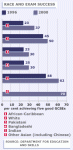 the national level have disappeared
 - Other ethnic groups, such as Chinese students, have far higher levels of attainment compared to the national level. It is worth highlighting however that Pakistani and Black Caribbean young people still have lower attainment levels than the national level.
- The data for 2010/11 is as follows:
- The national level, and the percentage of White British pupils achieving 5 A*-C grades including Maths and English, is 58%. This compares to around 45% in 2006/07
- Chinese students are the highest attaining group, with 78.5% achieving 5 A*-C grades including Maths and English. This compares to 70% in 2006/07
- Indian students are the second highest attaining group, with 74.4% achieving 5 A*-C grades including Maths and English. This compares to around 62% in 2006/07.
- Bangladeshi pupils now have a slightly higher attainment rate than White pupils, with 59.7% 5 A*-C grades including Maths and English. This is a massive improvement given that only around 40% achieved this 2006/07, which was 5% less than White pupils and the National Level.
- There has also been an improvement for Black African pupils, with 57.9% achieving 5 A*-C grades including Maths and English, compared to just over 40% achieving this in 2006/07. A similar level of improvement can be seen for mixed White and Black African pupils
- However, Pakistani and Black Caribbean young people still have lower attainment levels compared to the national level, with 52.6% and 48.6% respectively achieving 5 A*-C grades including Maths and English. This has, however, improved from around 35% for Pakistani and 34% for Black Caribbean pupils in 2006/07.
- Travellers, Gypsies and Roma are still the lowest achieving groups, with 17.5% of Irish Travellers and 10.8% of those from Gypsy or Roma backgrounds achieving 5 A*-C grades including Maths and English. This has improved from 2006/07 when only 5% of these groups combined achieved the required grades.
Taken from: http://www.education.gov.uk/rsgateway/DB/SFR/s001057/index.shtml
English Baccalaureate attainment
- Inequalities are more pronounced when looking at those who achieved the English Baccalaureate measure of attainment. This requires 5 A* – C grades in GCSE maths; English; two science subjects; a foreign language; and either history or geography.
The 2010/11 data is as follows:
- 34.6% of Chinese students and 25.8% of Indian students achieve the English Baccalaureate
- 15.4% of White students achieve the measurement
- 11.2% of Black African and 11.1% of Pakistani pupils achieve the English Baccalaureate
- The rate is 9.9% for Bangladeshi pupils and 7.6% for Black Caribbean pupils
- Traveller and Roma/Gypsy pupils have the lowest attainment, with 2.2% and 0.5% respectively achieving the measurement
Taken from: http://www.education.gov.uk/rsgateway/DB/SFR/s001057/sfr03-2012.xls
Specific issues:
Success of previous policies
- It could be argued that some of the improvement in the educational attainment of ethnic minorities was due to overall investment in education by the last government, and also due to the previous government introducing specific policies to boost attainment off specific groups, such as: The Ethnic Minority Achievement Grant (details below)
- The Aiming High programme for Black pupils: In participating schools this resulted in high increases in attainment at aged 14 Education Action Zones: Set up in 1998 to improve attainment in inner city areas The Training and Development Agency (TDA) had targets for recruiting ethnic minority teachers, and also developed the excellent Multiverse website providing culturally diverse resources for teachers and trainees. Multiverse and the TDA have now been scrapped by the current government. Citizenship Education, made compulsory in 2002, has played an important role in encouraging pupils to participate positively and effectively in an ethnically diverse society
The Ethnic Minority Achievement Grant
- The Ethnic Minority Achievement Grant (EMAG) was set up to narrow achievement gaps for pupils from the minority ethnic groups who are at risk of underachieving, and to meet the needs of bilingual pupils. In April 2011, EMAG was abolished in its current form. It has been mainstreamed into the ‘dedicated schools grant’, removing its ring-fenced status. This means that schools will now have the power to reduce the level of specialist provision to minority ethnic children at their discretion. The risk is that schools with use the already limited funds targeted at raising the achievement of minority ethnic pupils and spend them on other areas.
Pakistani and Bangladeshi pupils
- Overall, Pakistani and Bangladeshi pupils have traditionally had lower attainment than Indian students, which can largely be explained by poverty, social background, and the fact that English is a second language for many.
- However, the overall attainment of Bangladeshi pupils has been improving at a faster rate than Pakistani pupils and now a higher percentage of Bangladeshi pupils achieve 5 A*- C grades, including Maths and English, at GCSE than White pupils.
- Despite this, when looking at English Baccalaureate attainment a smaller proportion of Bangladeshis achieve this than Pakistani pupils. It is difficult to determine exactly the reasons behind these variations. However, the different between Bangladeshi and Pakistani attainment could be partly explained by the high concentration of Bangladeshis in Tower Hamlets, where educational attainment of this group has risen particularly rapidly in the area. Given the size of the Bangladeshi population in the borough, this could skew the overall averages. A Harvard study into educational differences between Bangladeshis and Pakistanis in London also recognised the impact success in Tower Hamlets has had on overall averages, particularly citing the borough’s success in recruiting teachers from Bangladeshi backgrounds, arguing that this improves understanding of language and other needs.
The complete text above was taken from http://www.runnymedetrust.org/uploads/Parliamentary%20briefings/EducationWHdebateJune2012.pdf
In 1975 The Sex Discrimination Act made it illegal to discriminate for employers to discriminate an the basis of gender. Such an act would not have had an immediate effect on girls at school but it could help explain the differences between Sue Sharpe’s findings in 1976 and those of 1994.
Interviews conducted by Sue Sharp show how girls’ attitudes to education and priorities in work and marriage changed.
In ‘Just Like A Girl‘, 1976, they were ‘love, marriage, husbands and career, more or less in that order. However by 1996 they’d switched to ‘job, career and being able to support themselves’ making girls:
- more confident
- more assertive
- more ambitious
- more committed to gender equality
Sharpe found the girls’ saw education as being the main route to a career, financial independence and the subsequent security that came with it.
It’s worth noting similar findings regarding girls’ aspirations were found by research conducted by the GirlGuides movement in 2012.
HIGHTOWN GRAMMAR Colin Lacey (1970)
The study deals with many aspects of the school:
- its changing function over the last fifty years
- its position within the present educational structure
- the way in which selection and anticipatory socialisation affect the pupils
- the process of sub-culture formation within the student body
- staff and staff-pupil relationships
Though the case study is of one school, its significance is not confined to the particularistic concerns of one school. It extends to general problems in sociology and education.
The study was based on Lacey’s belief that the particularistic (study of a single case) can illuminate the universalistic (other similar situations). That is, case studies are generalisable. (This view is not held by everyone.)
In the study, the school was viewed as a social system which was nevertheless embedded in a wider society. In the case study, Lacey lays bare the social mechanisms within the school in an attempt to explain the disappointing performance of working-class boys in grammar schools.
The following sections deal with some of the practicalities and issues that needed consideration during the period of the study…
Access: gained permission from the Chief Education Officer and the head teacher. (NOTE: At this period in history, it was not considered necessary to consult the staff!)
Mutual benefit: agreed to ‘repay’ the favour by including some teaching as an essential part of the field work.
Familiarization: spent two months getting to know the way around, meeting and talking to staff and pupils and explaining his purpose and presence in the school.
Data collection:
- observed teachers giving lessons (at least one by every member of staff) to gain a clearer picture of what was happening in the school
- spent twelve weeks sessions per week teaching and twelve observing teachers at work which continued over eighteen months
- engaged staff and pupils in informal conversations
- during the first term, Lacey sent out two questionnaires to 1st years (Year 7) and 5th years (Year 11) after their exams asking details about values, career aspirations, family background and peer group affiliation
- material from school records and the local education offices were also used
Lacey also discloses other relevant information
- he immersed himself in school life
- he ran the cricket team
- he went on a number of school trips
- his own home was very close to the school
Lacey wrestled with a difficult ethical issue during the study
He was aware that certain teachers who struggled to keep control preferred to hold their own private detention classes instead of using the official register book which would have betrayed their difficulties to colleagues. A senior teacher told Lacey that he was sure that some staff were using private detentions but uncertain who it was or how widespread. Lacey decided to remain silent.
A case study within a case study
Within this case study of the school, Lacey includes a number of representative case studies to illustrate the nature of the relationship between a number of a major social factors:
- social class
- academic achievement
- parental encouragement
Main findings
- the existence of tremendous energy and drive towards academic achievement
- the demoralisation of academically less successful pupils
- the school structure over-emphasised competition to the detriment of low achievers
- a sub-culture of low achievers absorbed too much staff time and energy
- low income families were more likely to be represented in the low achievement groups
In his summary, Lacey confirms that his findings agree with certain previously held positions and conflicts with other authors’ claims. That is, he sets his own findings within the existing body of knowledge.
Recommendations
- a system of cross-ability grouping should be adopted rather than streaming
- sets (differentiation) should be used as a teaching approach within each group
- some staff should be released from a full teaching load and trained to give support and counsel to under-achievers
Note the thoroughness with which Lacey approached this study. Your study is unlikely to be in the same depth as Hightown Grammar but requires the same degree of careful thought, planning and execution.
http://www.edu.plymouth.ac.uk/resined/Case_study/hightown.htm


Giddens’s argues modern relationships are built on intimacy, closeness and emotion, while in the past they were constructed around duty and obligation.
Traditional images of romantic love are often viewed as ‘forever after’ what we term monogamous love. Yet the reality is ‘romantic love’ tends to let us down and because of this sociologists like Giddens’ talk of confluent love (it sometimes easier to view confluent love as contemporary love).
Contemporary love is where people separate or divorce when the relationship isn’t working for them. Hence modern relationships ‘confluent love’ only lasts as long as partners find satisfaction and fulfillment which contrasts with the sense of duty or economic dependence more traditionally seen as being the adhesive which holds couples together.
Giddens writes: ‘Unlike romantic love, confluent love is not necessarily monogamous, in the sense of sexual exclusiveness. What holds the pure relationship together is the acceptance on the part of each partner, ‘until further notice’, that each gains sufficient benefit from the relation to make its continuance worthwhile. Sexual exclusiveness here has a role in the relationship to the degree to which the partners mutually deem it desirable or essential’ (from Giddens (1992).
Giddens’ ideas might go some way in explaining frequency of divorce being at its highest among couples in their 20s. The following articles discusses the growing trend it what has become termed ‘starter marriages’ and the stigma of being ‘left on the shelf’.
Can you imagine the avert below having any meaning to the audience if a sense of duty was the only keeping couples together?
Some experimental methods have been used in sociology in the guise of field experiments. Field experiments are conducted in the real world in real conditions such as a school while at the same time trying to follow similar procedures to those found in any laboratory experiment.
They tend to be carried out by interpretivists who are interested in looking for meanings in the social world.
Rosenthal and Jacobson conducted a field experiment in a school in 1968. This involved testing the hypothesis teacher expectations hand important effects on pupils academic performance in order to see if the self-fulfilling prophecy existed.
The trouble is this form of ‘real-world’ experiment is fraught with ethical problems as it could have been the teachers expectations and those students labelled with low expectations could have been damaged by the label.

 sociologytwynham.com